AI Development Team Structure: The Proven Roles to Avoid Mistakes
AI development team structure decides whether an AI project reaches production or stalls after the demo. O Clock Software, headquartered in Chennai, India, has delivered 1,000+ software projects since 2009. In that time, we have seen strong ideas fail for one simple reason: the right people were not in the room.
This guide explains the core AI team roles, how the team changes from pilot to production, and which roles you can share. It is written for founders, CTOs and product leads planning their first or next AI project.
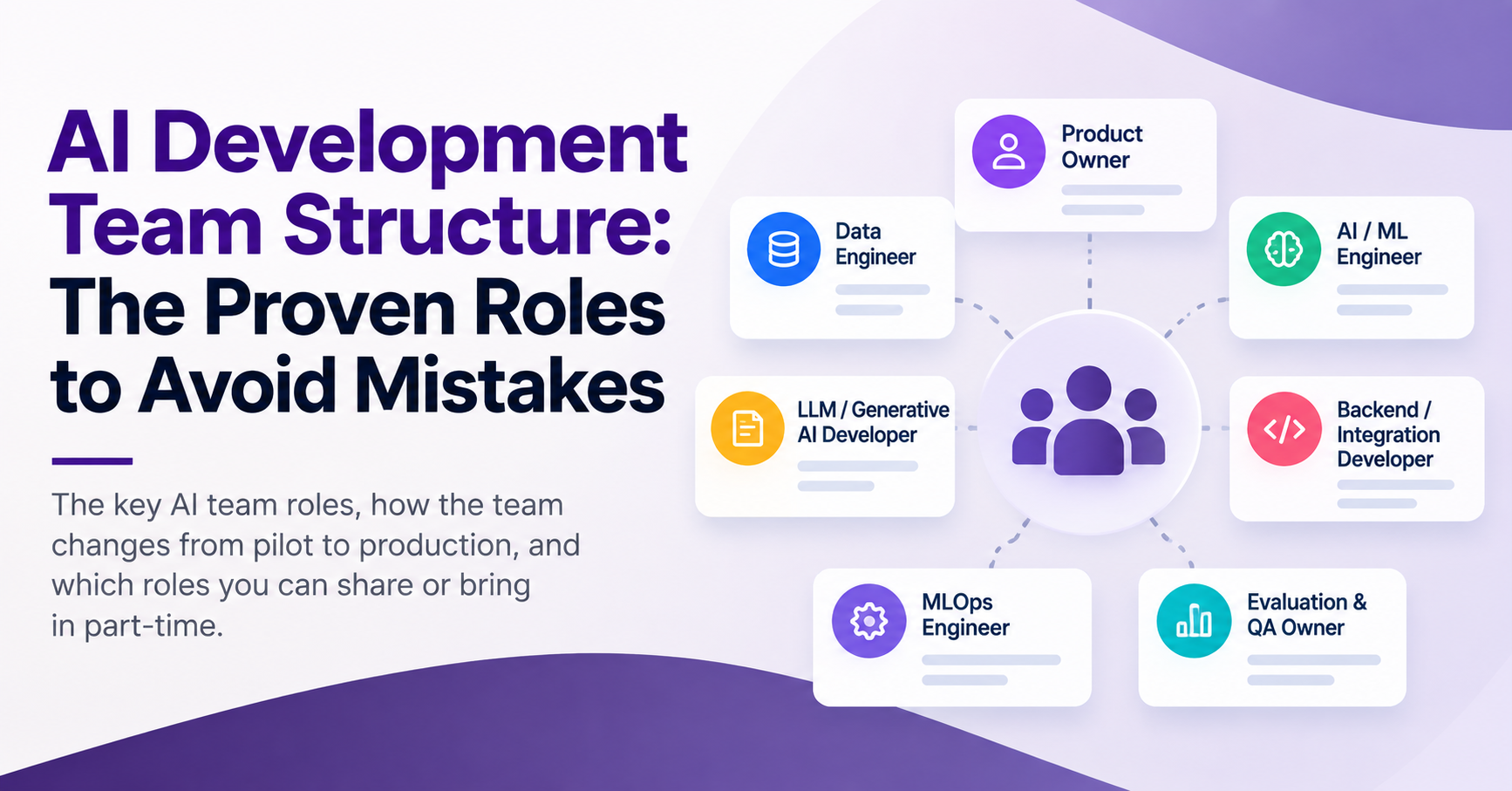
Quick answer: A typical AI development team structure has a product owner, one or more AI or LLM developers, a data engineer and, before launch, an MLOps engineer and an evaluation owner. Small pilots need two or three people. The team grows as the work moves toward production, and some roles can be shared or part-time.
AI development team structure: the core roles
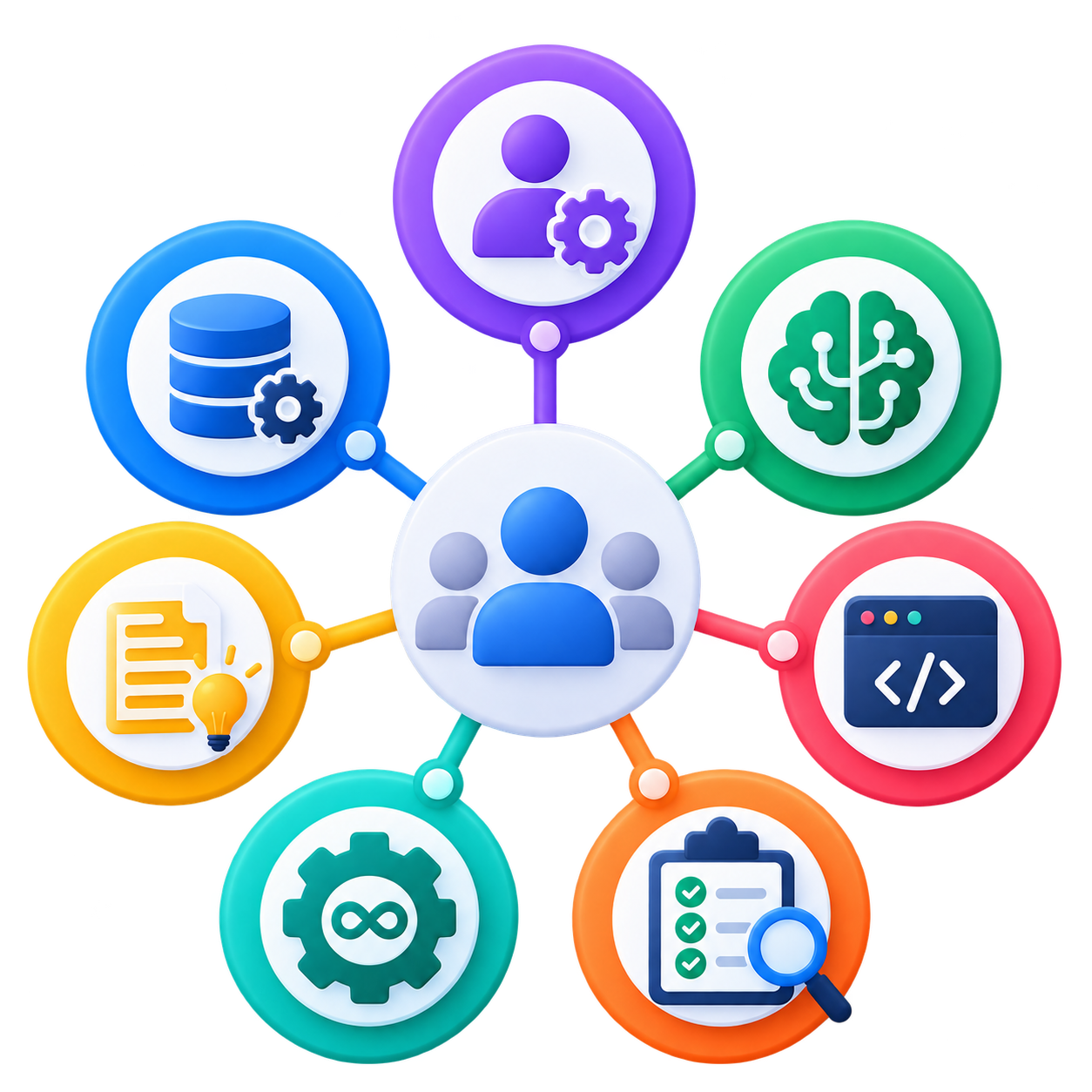
Every AI project needs the same few jobs done, even if one person does two of them. The table shows the core roles in an AI team and when each one becomes necessary.
| Role | What they own | When you need them |
|---|---|---|
| Product owner | The problem, the users and the success measure | From day one, usually from your side |
| AI / ML engineer | Models trained on your data for prediction, classification or ranking | When the task depends on patterns in historical data |
| Generative AI / LLM developer | Applications on large language models, including RAG assistants and agents | When the task is language-based: answering, drafting or extracting |
| Data engineer | Pipelines that collect, clean and deliver data | As soon as data sits in more than one system |
| Backend / integration developer | APIs and connections to your CRM, ERP or app | When the AI must work inside existing software |
| MLOps engineer | Deployment, monitoring and retraining | Before the first production release |
| Evaluation and QA owner | Test sets, accuracy checks and release sign-off | From the first prototype onward |
Two roles are easy to forget. The product owner keeps the work tied to a business result. Meanwhile, the evaluation owner makes sure “it works” means something measurable. Without them, teams often build impressive demos that nobody uses.
AI team roles by project stage
A good AI project team grows in steps. You do not need everyone on day one, and adding people too early slows decisions down.
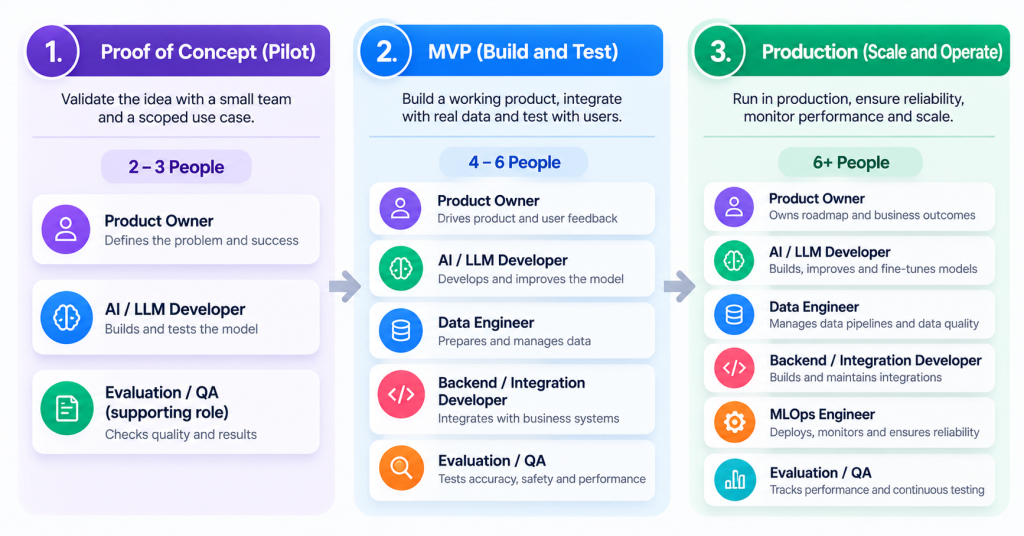
Proof of concept: two or three people
At this stage, the goal is to prove the idea works on real data. One AI or LLM developer does most of the build. A data engineer helps part-time to reach and clean the data. On your side, a product owner sets the goal and judges the result.
MVP: four to six people
Next, the idea becomes something real users can try. A backend developer connects the AI to your systems. A second AI developer often joins to speed up the work. Also, an evaluation owner starts building a proper test set, so every change can be measured.
Production: six or more people
Finally, the system has to work every day. An MLOps engineer sets up deployment, monitoring and retraining. Security and access rules get a named owner. In addition, someone is on point for incidents after launch. For a closer look at this stage, see AI proof of concept to production.
Roles you can share or bring in part-time
Not every role needs a full-time person. In fact, several roles in an AI team work well as shared or part-time positions, especially early on.
- Data engineer: Often part-time in a pilot, then full-time once several data sources feed the system.
- MLOps engineer: Part-time until the first release, then steady but often shared across projects.
- Evaluation and QA owner: Can be part of a QA engineer’s role, as long as one person owns the test set.
- Solution architect: Usually needed for design reviews at key points, not every day.
However, two roles should never be part-time: the product owner and the lead AI developer. If either one is split across too many projects, decisions slow down and quality drops.
Who owns what in an AI project team
Clear ownership prevents the most common arguments in an AI project team. Before work starts, write down who decides what.
| Area | Owner | Typical decisions |
|---|---|---|
| Product | Product owner | Which problem to solve, who the users are, what success means |
| Data | Data engineer, with your data owner | Which sources to use, who can access them, how long to keep them |
| Model | Lead AI or LLM developer | Which approach and model to use, how to improve accuracy |
| Infrastructure | MLOps engineer | Where the system runs, how it is monitored, when it is retrained |
| Risk and security | Named lead on your side | Privacy rules, human review steps, what the AI may not do |
For the risk row, frameworks such as the NIST AI Risk Management Framework give a useful list of questions to answer.
Gaps in AI development team structure that stall projects
Most stalled AI projects we review have the same few gaps in their AI development team structure:
- No data engineer. The AI developers spend their time cleaning data instead of building.
- No product owner. The team builds what is interesting, not what the business needs.
- No evaluation owner. Nobody can say whether a new version is better or worse.
- No MLOps before launch. The model works in testing, then drifts quietly in production.
- No integration developer. The AI works on its own but never reaches the tools people use.
Each gap has a simple fix: name an owner before the stage where that gap starts to hurt. If you are hiring for these roles now, our guide to hiring AI developers walks through the process step by step – Hiring AI Developers: The Proven Way to Actually Avoid Mistakes.
Building your AI development team structure with O Clock Software
You do not have to fill every role yourself. Our Forward Deployed Engineers embed with your team and own delivery from discovery to production. For language-based products, our LLM Developers build assistants, agents and search. If you need a full team, see Enterprise Solutions & Dedicated Teams. For project-based delivery, explore AI Solutions & Services.
Get a team plan for your AI project →
Frequently asked questions about AI development team structure
How many people does an AI development team need?
A proof of concept usually needs two or three people, an MVP four to six, and a production system six or more, depending on how many systems the AI connects to. The right AI development team structure grows with the project. Start small, prove the idea on real data, then add roles as each stage needs them.
What is the difference between an AI engineer and an ML engineer?
An ML engineer trains models on your own data for tasks like forecasting or classification, while an AI engineer more often builds applications on existing models such as large language models. In practice, the titles overlap. So look at what the person has built, not only their job title.
Do I need a data scientist on an AI project?
You need a data scientist when the main work is exploring data and designing new models; many LLM-based projects can start without one. For assistants, search and agents, an LLM developer and a data engineer are often enough. A data scientist becomes important for forecasting, scoring and other prediction work.
Who should manage an AI development team?
A product owner should set the goals, and a technical lead should run the day-to-day work, ideally with both named before the project starts. The product owner usually comes from your business. The technical lead can be in-house or from a partner, as long as one person is accountable for delivery.
What does an MLOps engineer do?
An MLOps engineer deploys AI models, monitors their accuracy in production and sets up retraining when the data changes. Without this role, models that work well in testing can slowly lose accuracy after launch. Bring an MLOps engineer in before the first production release, not after a problem appears.
Can one developer build an AI product?
One experienced developer can build a proof of concept, but a production AI product needs more roles to stay accurate, secure and connected to your systems. Data work, integration, monitoring and evaluation each take real time. Trying to cover them all with one person is a common reason projects stall.
About O Clock Software
O Clock Software is a software and AI development company headquartered in Chennai, India. Since 2009, it has delivered 1,000+ projects for clients in 12+ countries, with offices in Singapore, the USA, Malaysia and Saudi Arabia. About O Clock Software.