Outsourced AI Development: How to Actually Avoid the Mistakes
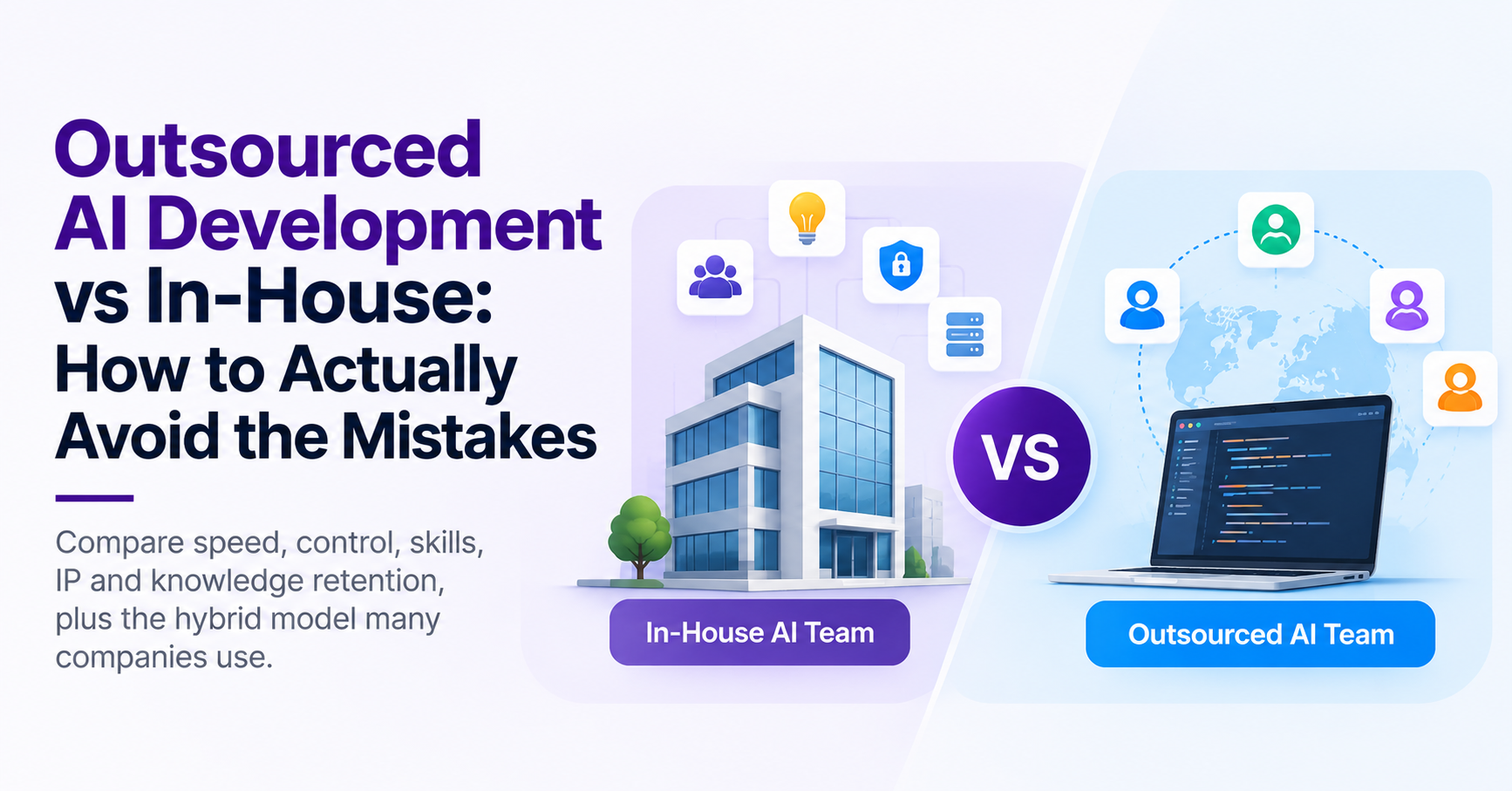
Outsourced AI development and an in-house AI team can both deliver strong results, but they suit different situations. O Clock Software, headquartered in Chennai, India, has delivered 1,000+ software projects since 2009. We work with companies on both sides of this choice, and the right answer depends on a few clear factors.
This guide compares the two models side by side. It then shows when each one wins, how the hybrid model works and how to keep your IP and knowledge safe when you outsource AI development.
Quick answer: Build an in-house AI team when AI is core to your product for years and you can wait to hire. Choose outsourced AI development when you need to start quickly, cover several skills at once or prove an idea first. Many companies use a hybrid: an in-house owner with an outside build team.
Outsourced AI development vs in-house: side by side
The table compares the two models on the factors that matter most to technology leaders.
| Factor | In-house AI team | Outsourced AI development |
|---|---|---|
| Time to start | Weeks to months of recruiting | Usually much faster, with engineers already on staff |
| Control | Full, day-to-day control | Shared; set through scope, reviews and reporting |
| Range of skills | Limited to the people you hire | Access to several specialists, such as LLM, data and MLOps |
| Knowledge retention | Stays in the company | Must be planned through documents and handover |
| Scaling up or down | Slow; hiring and notice periods apply | Faster; the partner adjusts the team |
| IP ownership | Yours by default | Yours when the contract says so |
| Management load | You manage every role | The partner manages its team; you manage the partner |
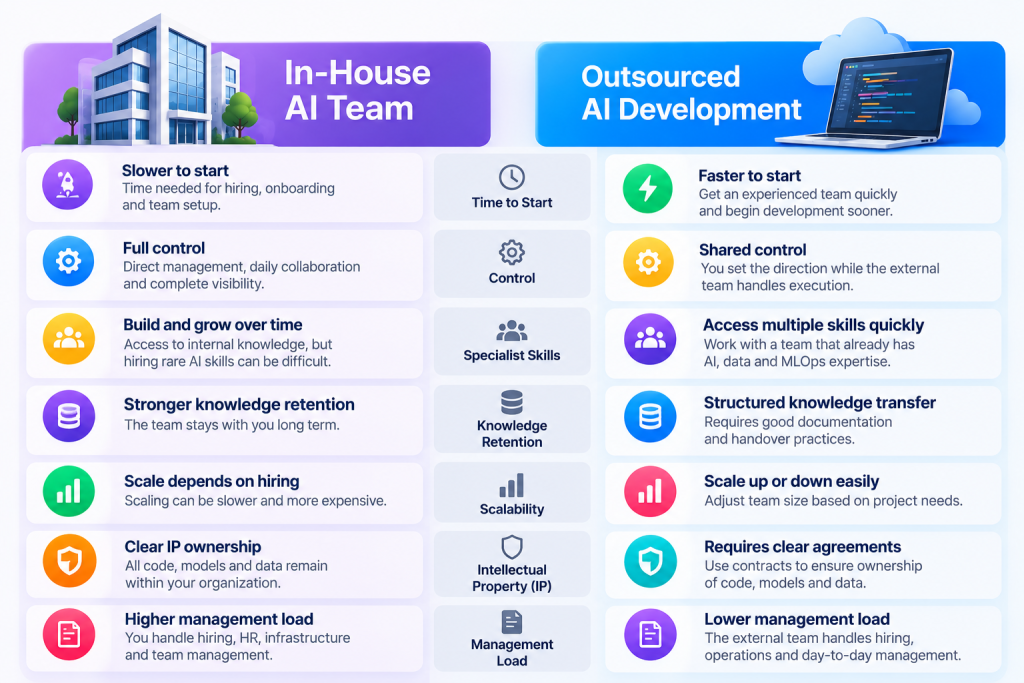
Neither column is better on every row. Instead, the right choice depends on which rows matter most for your project right now.
When an in-house AI team is the right call
An in-house AI team makes the most sense when AI is the product, not a feature. Consider building in-house when:
- AI is central to how your product competes for the next several years.
- The work needs deep, daily contact with your customers or internal experts.
- Your data is so sensitive that it cannot leave your own environment.
- You already have strong engineering leaders who can hire and guide AI specialists.
Even then, many teams start with outside help. As a result, they learn which roles they truly need before they hire full-time.
When outsourced AI development is the right call
Outsourced AI development works best when speed and range of skills matter more than building a large team yourself. It is usually the better choice when:
- You need to prove an idea on real data before committing to a full build.
- The project needs several skills at once, such as LLM development, data engineering and MLOps.
- Hiring experienced AI engineers in your market is slow.
- The AI is one part of a larger product, and your own team is busy with the rest.
In short, outsourcing lets you start sooner and learn faster. However, it only works well when you plan for ownership from day one.
The hybrid model: in-house owner, outside build team
Many companies end up with a hybrid. One or two people in-house own the product and the data. Meanwhile, an outside team does most of the building. This keeps control and knowledge with you while giving you access to specialists.
A typical hybrid setup works like this:
- Your product owner sets goals, priorities and the success measure.
- Your technical lead reviews designs and code, and joins key decisions.
- The outside team builds, tests and deploys the AI system.
- Both sides hold a weekly demo and review against the agreed measure.
- Over time, your in-house AI team takes on more of the work, if that is the plan.
The hybrid model also makes a later move in-house much easier. Because your own people are involved from the start, the knowledge does not sit only with the partner.
How to outsource AI development and keep your IP
When you outsource AI development, ownership has to be written down, not assumed. Put these points in the agreement before work starts:
- Code and models: You own the source code, trained models, prompts and configuration built for your project.
- Data: Your data stays yours, is used only for your project and is deleted or returned at the end.
- Repositories: Code lives in a repository you control, with the partner given access, not the other way around.
- Documentation: Architecture notes, data flows and runbooks are part of the deliverables.
- Handover: A handover period is agreed in advance, in case you bring the work in-house later.
If intellectual property terms are new to you, the World Intellectual Property Organization’s overview is a clear place to start. For anything binding, ask your own legal advisor to review the contract.
Offshore AI development: what changes
Offshore AI development adds distance and time zones to the picture. Handled well, it changes the rhythm of the work more than its quality. Three things need extra attention:
- Working-hour overlap: Agree on a daily window when both teams are online.
- Written communication: Decisions and requirements go into a shared tracker, not only into calls.
- Data location: Confirm where data is stored and processed, and which local laws apply.
We cover these points in more depth in AI outsourcing to India [link to article 9 once published]. For choosing the partner itself, see our AI development partner checklist.
Outsourced AI development with O Clock Software
If outsourcing or a hybrid model fits your project, our team can start with a short scoping phase on your real data. For project-based work, see AI Solutions & Services. To add engineers to your own team instead, you can hire AI developers as dedicated specialists. For wider product builds, explore Custom Software & Product Engineering.
Discuss a hybrid setup for your AI project →
Frequently asked questions about outsourced AI development
Is it safe to outsource AI development?
Yes, outsourced AI development is safe when the contract covers data handling, access rules and ownership, and the partner can show how it protects client data in practice. Ask how data is stored, who can reach it and what happens to it at the end of the project. Also check that the partner’s team signs confidentiality terms.
Who owns the IP when AI development is outsourced?
The contract decides ownership, so it should state that you own the code, trained models, prompts and data created for your project. Without clear terms, ownership can be unclear later. Also confirm that the code lives in a repository you control, and ask a legal advisor to review the agreement.
How do you keep knowledge in-house when outsourcing?
Keep a product owner and a technical lead on your side, and make documentation and a handover period part of the agreed deliverables. Weekly demos and design reviews help your team understand how the system works. As a result, you can take over the work later without starting again.
Can an outsourced team work alongside my developers?
Yes, many outsourced AI teams work inside the client’s own tools, code reviews and planning, as an extension of the in-house team. This hybrid setup works best when both sides agree on who decides what. A shared tracker and a regular demo keep everyone aligned.
How quickly can an outsourced AI team start?
An outsourced AI team can usually start much sooner than an in-house hire, because the engineers are already employed and onboarded. The first step is often a short scoping phase on your data. That phase confirms the approach before the full team joins.
What should an AI outsourcing agreement include?
An AI outsourcing agreement should cover scope, success measures, IP ownership, data handling, security, documentation and a handover plan. It should also say how changes to scope are agreed. Clear terms at the start prevent most disputes later in the project.
About O Clock Software
O Clock Software is a software and AI development company headquartered in Chennai, India. Since 2009, it has delivered 1,000+ projects for clients in 12+ countries, with offices in Singapore, the USA, Malaysia and Saudi Arabia. About O Clock Software.