How AI Is Reshaping Mobile App Development in 2026: From Smart Features to Intelligent Digital Ecosystems
A few years ago, adding AI to a mobile app usually meant one thing: a chatbot sitting in the corner of the interface pretending to be intelligent.
That phase is ending quickly.
In 2026, AI is no longer arriving as a visible feature. It is becoming part of the operational fabric of the product itself. The most important architectural changes are happening beneath the UI layer — inside workflows, orchestration systems, personalization engines, predictive infrastructure, and decision pipelines.
The mobile app is still important, but it is no longer the center of the system.
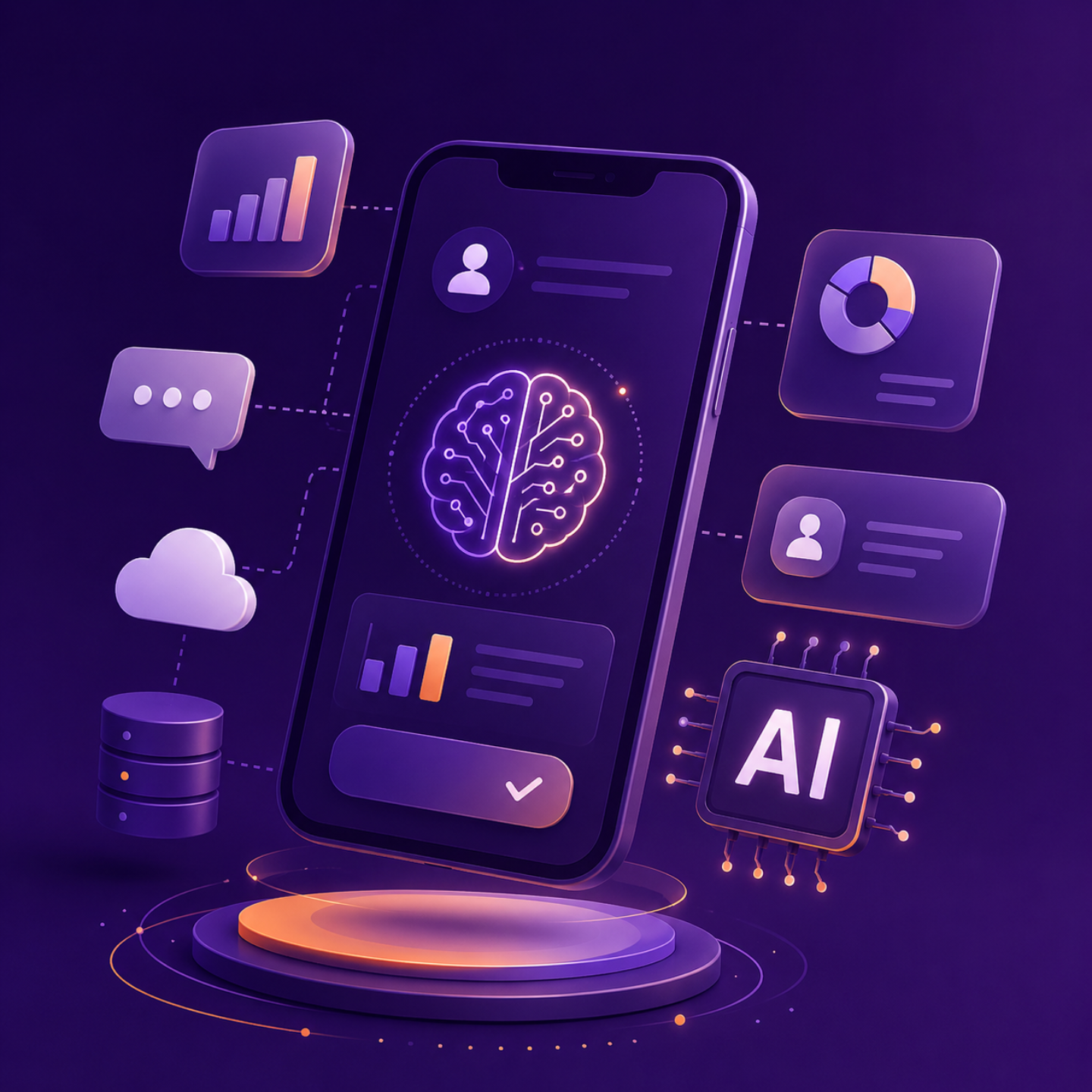
It is increasingly becoming the visible surface of a much larger intelligent ecosystem.
“The interface is no longer the system. Intelligence is.”
This shift is changing how engineering teams think about product development. At O Clock Software Pvt Ltd, we are seeing a noticeable transition in client expectations across healthcare, logistics, SaaS, retail, and enterprise platforms. Businesses are no longer asking for “AI features.” They are asking for systems that can anticipate actions, reduce operational friction, and continuously improve user workflows.
That distinction matters more than most companies realize.
AI Features Are Becoming Invisible
The early AI wave focused heavily on visibility. Products wanted users to see the AI. Voice assistants, recommendation popups, auto-generated content blocks — everything was intentionally obvious.
Now the market is moving toward invisible intelligence.
Users increasingly expect applications to understand intent without forcing repetitive actions. The best AI experiences today often feel almost unnoticeable because they remove decisions instead of adding interactions.
Think about how modern mobile platforms are evolving:
Traditional Apps vs AI-Native Apps
| Traditional Mobile Apps | AI-Native Mobile Systems |
|---|---|
| User-driven workflows | Predictive workflows |
| Static UI states | Context-aware interfaces |
| Manual navigation | Intent-based actions |
| Reactive notifications | Behavioral anticipation |
| Feature-centric architecture | Intelligence-centric architecture |
This is where many product teams struggle. They still treat AI as an enhancement layer attached to an existing app structure. But AI-native systems require architectural redesign, not interface decoration.
“Fast AI adoption often exposes weak architecture faster.”
Applications built around rigid APIs, fragmented backend services, or disconnected data models quickly hit limitations when intelligence becomes deeply integrated into workflows. Prediction engines, adaptive experiences, and AI orchestration demand far tighter operational consistency than traditional mobile products ever required.
Ironically, AI is forcing companies to become better software engineering organizations before it delivers meaningful intelligence.
Predictive UX Is Replacing Reactive UX
One of the biggest changes happening quietly in mobile development is the transition from reactive interfaces to predictive experiences.
For years, mobile UX optimization focused on reducing taps. AI is now shifting the goal toward reducing decisions.
That sounds subtle, but it fundamentally changes product thinking.
A logistics platform no longer waits for warehouse managers to manually identify delays. The system predicts supply bottlenecks based on shipment behavior patterns. A healthcare application does not simply display patient history anymore; it surfaces risk signals before clinicians actively search for them. Retail platforms increasingly reorganize experiences dynamically based on behavioral probability instead of static merchandising logic.
The important part is not the AI model itself. It is the operational ecosystem surrounding it.
This is why mobile engineering in 2026 feels increasingly tied to data infrastructure, cloud orchestration, event streaming, and behavioral analytics. The boundaries between backend systems and mobile applications are disappearing.
Mobile developers are no longer only building screens.
They are designing decision environments.
“Users now compare software against the smartest product they used yesterday.”
That expectation escalation is happening faster than many enterprises anticipated. A smooth UI is no longer enough. Users increasingly expect systems to adapt in real time, remember context intelligently, and reduce cognitive load continuously.
And when products fail to do that, the experience suddenly feels outdated — even if the application itself is technically modern.
Intelligence Is Becoming Infrastructure
One of the more underestimated industry shifts is that AI is changing infrastructure priorities more aggressively than frontend priorities.
Most discussions still revolve around models and interfaces. In reality, engineering teams are spending more time redesigning data pipelines, event architectures, synchronization layers, and cloud scalability models.
Because intelligent systems behave differently from traditional software.
They require:
- continuous contextual learning
- real-time orchestration
- low-latency data movement
- adaptive workflow engines
- operational observability
- resilient API ecosystems
This is particularly visible in enterprise mobile platforms where multiple systems — ERP, CRM, IoT devices, RFID infrastructure, analytics layers, and customer applications — now operate as interconnected intelligence networks rather than isolated software products.
Reactive Workflows vs Intelligent Ecosystems
| Reactive Systems | Intelligent Ecosystems |
|---|---|
| Trigger-based actions | Predictive orchestration |
| Isolated applications | Connected operational layers |
| Fixed business rules | Adaptive intelligence models |
| Human-led workflows | Human-assisted automation |
| Static reporting | Continuous operational insights |
Many organizations are discovering that AI maturity is less about model sophistication and more about ecosystem readiness.
A mediocre model connected to strong operational infrastructure often outperforms a powerful model trapped inside fragmented systems.
That realization is reshaping technical leadership conversations in 2026.
The Future of Mobile Development Feels More Operational Than Visual
There was a time when mobile innovation was mostly visual. Better animations, smoother interactions, cleaner interfaces, faster responsiveness.
Those things still matter. But they are no longer the primary differentiator.
The next generation of successful mobile products will compete on operational intelligence — how effectively they connect workflows, reduce friction, automate coordination, and adapt to human behavior in real time.
That is a much harder engineering problem than building attractive interfaces.
It also explains why modern product engineering increasingly requires cross-functional thinking across AI systems, backend architecture, cloud infrastructure, mobile platforms, automation pipelines, and enterprise integrations. The companies moving fastest right now are not necessarily the ones shipping the most AI features. They are the ones building systems capable of evolving intelligently over time.
And that changes the role of mobile applications entirely.
The app is no longer just a product users interact with.
It is becoming the operational gateway into a continuously learning digital ecosystem.