How to Build a SaaS Product That Can Scale Globally Without Breaking Engineering, Operations, or User Experience

Global scale begins testing things companies often ignore during early momentum: latency across regions, infrastructure resilience, data compliance, billing complexity, mobile performance, multilingual workflows, AI processing costs, and the uncomfortable reality that users in different markets behave very differently from each other.
That is where many SaaS platforms begin slowing down technically while trying to grow commercially.
“Scaling globally is less about traffic volume and more about operational adaptability.”
A surprising number of products still treat scalability as a cloud problem. It is not. Infrastructure matters, but modern SaaS scalability is now deeply connected to product architecture, intelligence layers, automation maturity, and how quickly engineering teams can evolve systems without rewriting entire platforms every eighteen months.
The companies scaling effectively today are building products that behave more like adaptive systems than static applications.
The App Is No Longer the Entire Product
There was a time when SaaS architecture was mostly about dashboards, APIs, authentication, and database scaling. That model still matters, but it is no longer sufficient.
Modern SaaS products are increasingly expected to operate as intelligent ecosystems across web, mobile, integrations, AI services, automation pipelines, analytics engines, and enterprise workflows. The product is no longer confined to a single interface.
This changes how engineering teams must think from the beginning.
A globally scalable SaaS platform now needs:
- flexible service boundaries
- event-driven communication
- intelligent observability
- infrastructure portability
- API-first product thinking
- mobile-first operational consistency
The problem is that many startups still build version one as if scale can simply be “added later.”
It usually cannot.
The architecture decisions made during the MVP phase often become permanent operational debt. A monolithic backend that works beautifully for a local customer base may become painfully expensive when AI workloads, enterprise integrations, real-time synchronization, and multi-region deployments enter the picture.
This is exactly why experienced engineering partners matter early in the journey. Teams building scalable SaaS platforms often benefit from dedicated product engineering support across architecture, mobile systems, cloud infrastructure, and AI integration strategy. Companies looking to accelerate this process typically work with specialized development teams through services like Hire Developers and Hire AI App Developers to avoid rebuilding foundational systems later.
Global SaaS Architecture Is Becoming More Distributed
The old approach was simple: one server region, one primary database, one deployment pipeline.
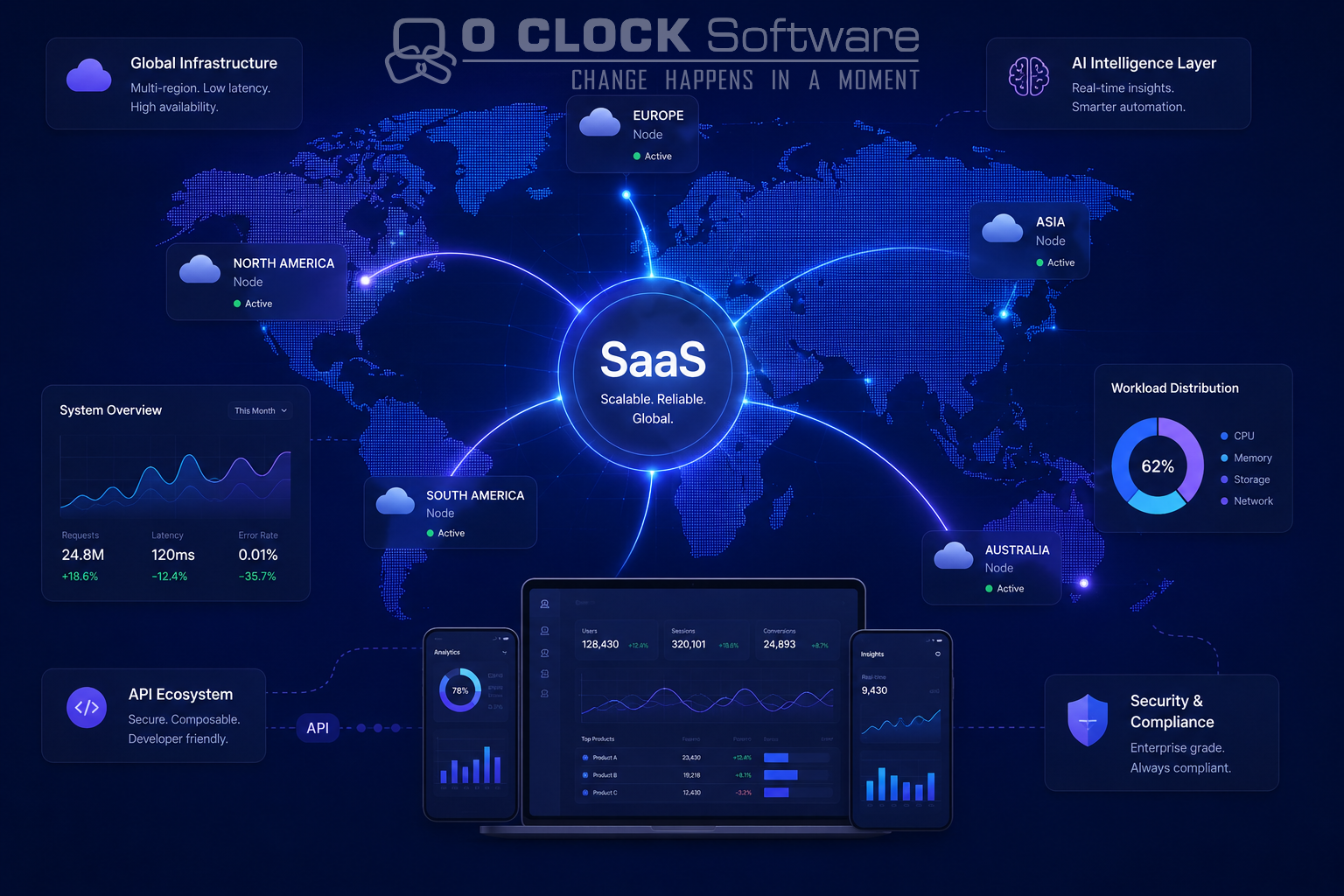
That model struggles under modern SaaS expectations.
Users now expect low latency regardless of geography. Enterprises expect compliance requirements to be respected across jurisdictions. AI-driven workflows require asynchronous processing pipelines that traditional request-response architectures were never designed to handle efficiently.
What used to be “advanced infrastructure” is quickly becoming standard operational design.
Traditional SaaS vs Global SaaS-Native Platforms
| Traditional SaaS | Global SaaS-Native Platforms |
|---|---|
| Single-region deployments | Multi-region infrastructure |
| Monolithic backend | Service-oriented architecture |
| Static workflows | Event-driven automation |
| Reactive support systems | Predictive operational monitoring |
| Feature-centric UX | Context-aware intelligent UX |
The most effective SaaS products today are designed around adaptability.
Not perfection.
That distinction matters because scalability is rarely linear. Markets evolve unexpectedly. AI costs fluctuate. User behavior changes. Integration ecosystems expand. Compliance requirements shift. Engineering teams themselves grow and restructure over time.
Rigid systems suffer under that pressure.
“The real scalability challenge is not handling more users. It is handling more complexity without slowing product evolution.”
This is where technologies like Flutter, React Native, Node.js, Laravel, cloud-native APIs, containerized services, and intelligent orchestration layers become strategically important rather than simply fashionable technology choices.
Engineering velocity becomes a business capability.
AI Features Are Quietly Reshaping SaaS Expectations
Many companies are still treating AI like interface decoration.
A chatbot here. A recommendation engine there. Maybe a summarization feature placed somewhere inside the dashboard.
That phase is already fading.
AI is now influencing how SaaS products are architected operationally. Intelligent routing systems, predictive analytics, adaptive workflows, automated decision support, anomaly detection, contextual search, workflow optimization, and AI-assisted operations are becoming part of core product expectations.
Users are no longer impressed merely because AI exists.
They care whether the product feels smarter over time.
Reactive Software vs Predictive SaaS Systems
| Reactive Systems | Predictive SaaS Systems |
|---|---|
| Users initiate workflows | Systems anticipate workflows |
| Manual operational tracking | Automated operational intelligence |
| Static reporting dashboards | Real-time adaptive insights |
| Support-driven troubleshooting | Predictive issue prevention |
This shift changes backend requirements significantly.
AI-native SaaS products require:
- scalable data pipelines
- vector search infrastructure
- intelligent caching strategies
- asynchronous task orchestration
- usage-aware cloud optimization
- observability across AI services and APIs
And perhaps most importantly, they require cleaner data architecture.
Poor data discipline quietly destroys AI scalability.
Many SaaS platforms discover this too late.
Scalability Eventually Becomes an Organizational Problem
One of the biggest misconceptions in SaaS is that scaling problems are purely technical.
They are not.
At a certain stage, global SaaS complexity becomes operational and organizational. Engineering teams must coordinate across infrastructure, mobile platforms, APIs, DevOps, security, analytics, AI systems, customer workflows, and deployment reliability simultaneously.
Without strong engineering systems, growth begins creating friction faster than value.
This is why mature SaaS companies invest heavily in:
- internal platform tooling
- deployment automation
- observability systems
- CI/CD maturity
- architectural governance
- infrastructure monitoring
- developer experience optimization
Ironically, the companies moving fastest often appear slower internally because they spend significant time reducing operational chaos before it becomes expensive.
“Fast growth without operational maturity usually creates invisible technical debt at enterprise scale.”
This is also why mobile engineering now plays a much larger role in SaaS scalability than many organizations expected. Mobile applications are increasingly becoming primary operational interfaces for logistics teams, healthcare staff, retail operations, warehouse management, field services, and enterprise workflows.
The backend is no longer serving just a web dashboard.
It is serving an ecosystem of constantly active operational surfaces.
The Companies That Scale Best Think Beyond Software
The strongest SaaS platforms today are not winning because they have more features.
They are winning because their systems are operationally intelligent, architecturally adaptable, and easier to evolve under pressure.
That sounds subtle, but it changes everything.
Global SaaS growth is no longer simply a product challenge. It is a systems design challenge. Companies that understand this early tend to scale more sustainably, move faster operationally, and survive architectural transitions that slow down competitors for years.
The future of SaaS will belong to platforms that combine product engineering, AI intelligence, infrastructure flexibility, and operational automation into a single connected system.
Because at global scale, software is no longer just software.
It becomes infrastructure for how businesses operate.