Hiring AI Developers: The Proven Way to Actually Avoid Mistakes
Hiring AI developers works best when you start with the problem you want solved, not with a job title. O Clock Software, headquartered in Chennai, India, has delivered 1,000+ software projects since 2009. Across that work, one pattern repeats: teams that define the problem first hire faster and build the right thing.
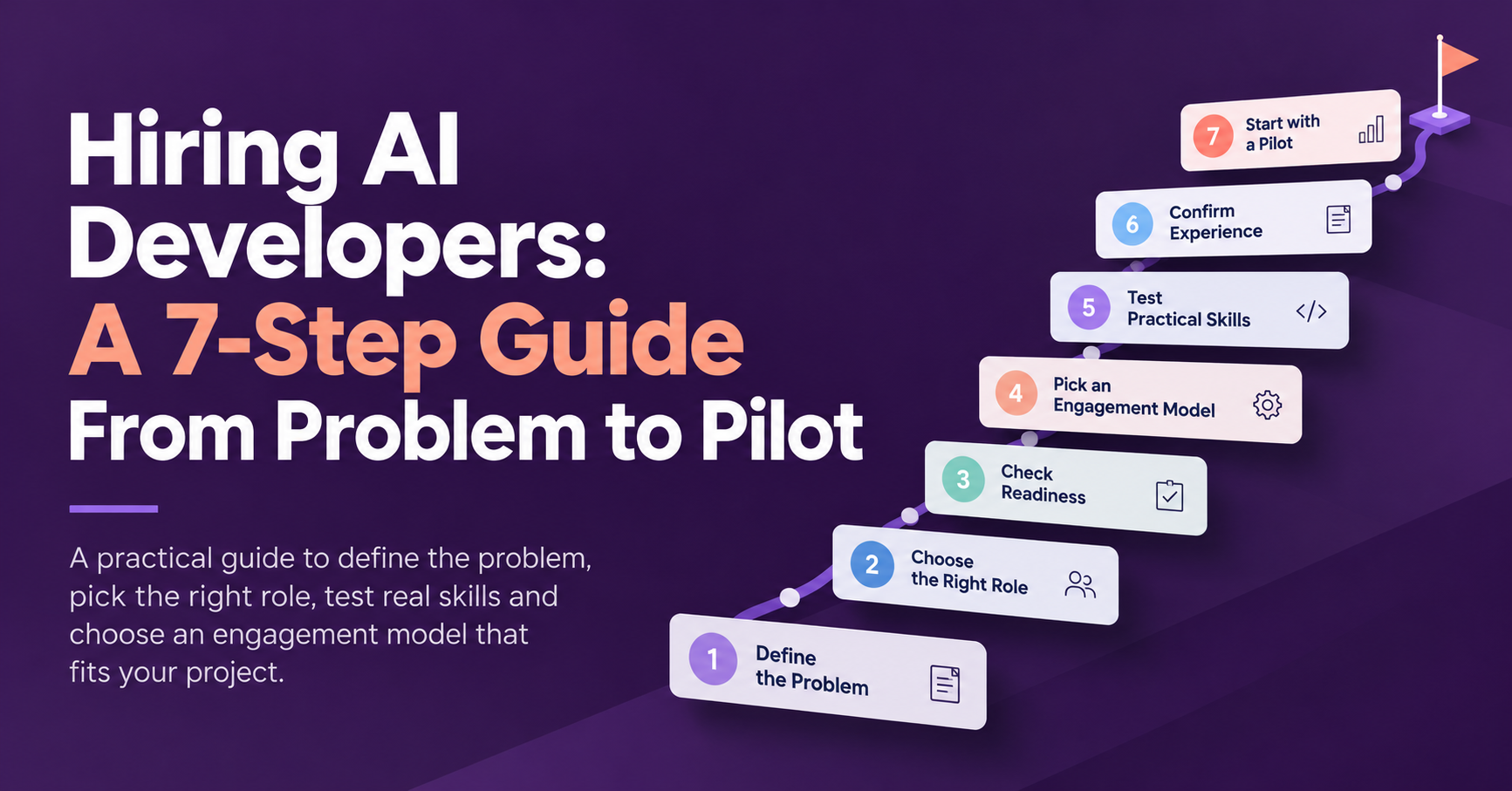
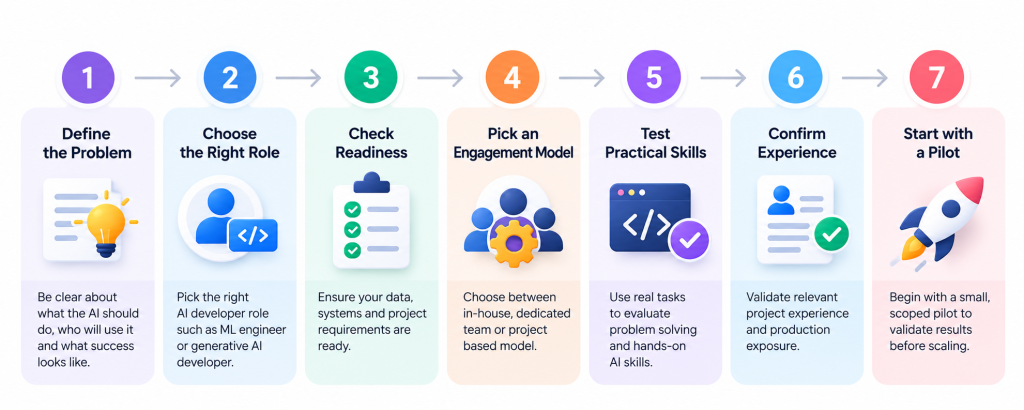
This guide shows how to hire AI developers in seven steps, from the first problem statement to a working pilot. It is written for founders, CTOs and product leads who need to bring AI skills into their business.
Quick answer: To hire AI developers, define the business problem first. Then choose the role that fits it, such as an ML engineer or a generative AI developer. Check that your data is ready, pick an engagement model, test practical skills, confirm production experience and start with a small, scoped pilot.
Hiring AI developers starts with the problem
Many AI hires go wrong before the first interview. The job post asks for “an AI developer,” but nobody has written down what the AI should do. As a result, candidates are judged on buzzwords instead of fit.
AI is a broad field. A developer who builds chatbots on large language models works very differently from one who trains forecasting models on sales history. So the first question is not “who should we hire?” It is “what should the system do, and how will we know it works?”
Once that is clear, the rest of the AI developer hiring process gets much simpler. You know which skills to test, which experience matters and what a good first result looks like.
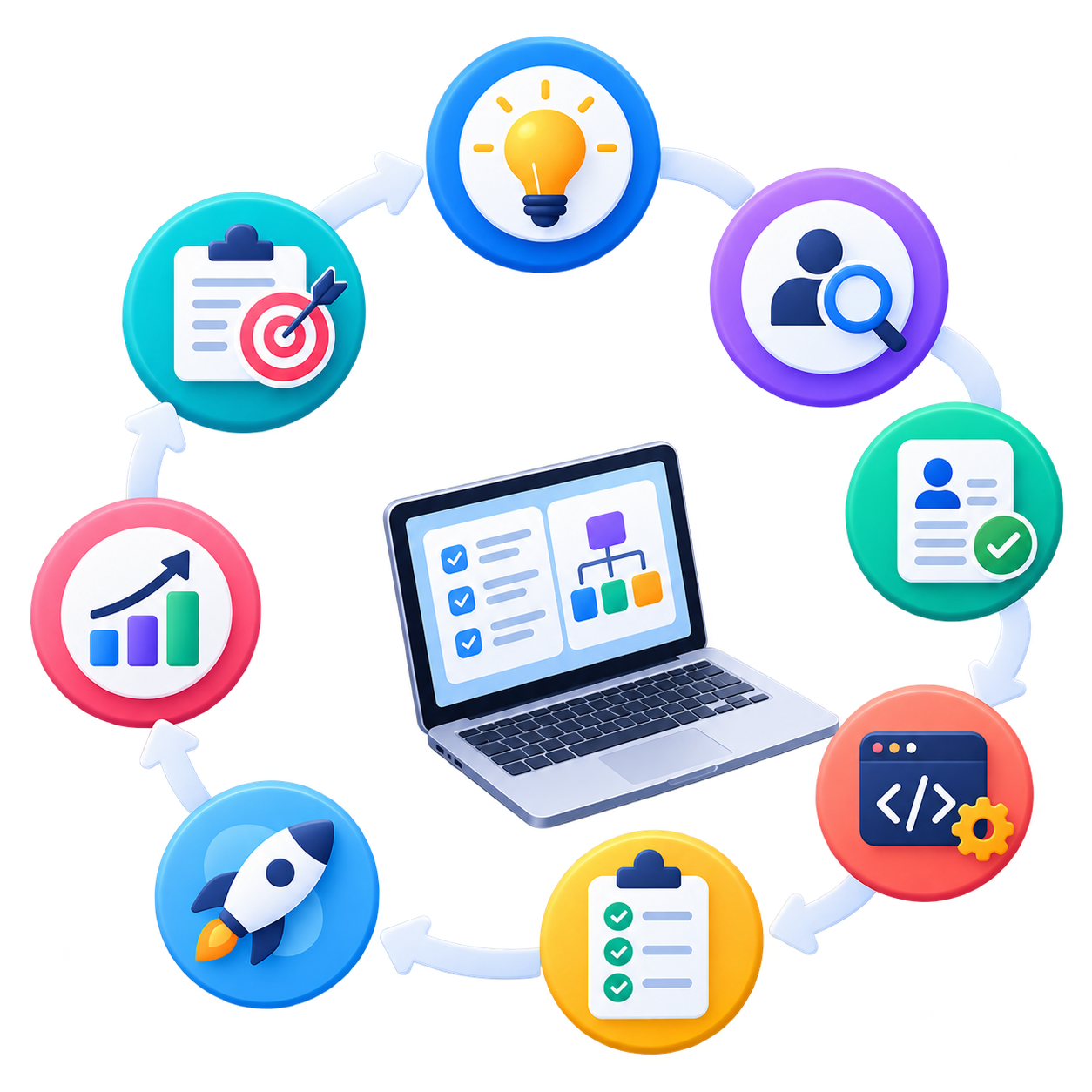
How to hire AI developers in 7 steps
The steps below follow the order we use with clients. Each one removes a common cause of a poor hire.
Step 1: Define what the AI should do
Write one paragraph that describes the task. Name the users, the input, the output and the decision it supports. For example: “Support agents get a suggested reply to each customer email, drawn from our help center, within ten seconds.”
Next, define success in terms you can check. That might be answer accuracy on a test set, time saved per case or the share of tasks completed without help. If you cannot measure it, you cannot tell strong work from weak work.
Finally, list the limits. Note where the data lives, what must stay private and which systems the AI has to connect to.
Step 2: Pick the right AI role
“AI developer” covers several jobs. Matching the role to the problem is the biggest single decision when hiring AI developers. The table shows the most common roles.
| Role | What they build | Hire when |
|---|---|---|
| AI app developer | Web and mobile apps with AI features such as search, assistants and recommendations | You are adding AI to a product people use every day |
| Generative AI / LLM developer | Applications on models such as GPT, Claude or Llama, including RAG assistants and agents | The task is language-based: answering, drafting, summarizing or extracting |
| Machine learning engineer | Models trained on your data for prediction, classification or ranking | You have historical data and a clear numeric target, such as demand or churn |
| Data engineer | Pipelines that collect, clean and deliver data to models | Your data is spread across systems or needs cleanup first |
| MLOps engineer | Deployment, monitoring and retraining pipelines | A model is moving into production and must stay accurate |
Many projects need two roles at the start, for example an LLM developer and a data engineer. For a closer look at how these roles fit together, see our guide to AI development team structure.
Step 3: Check that your data is ready
AI developers can only work with the data you give them. Before you hire, check three things:
- Access: Can the team reach the data without months of approvals?
- Quality: Is it complete, labeled where needed and reasonably clean?
- Rules: Which fields are personal or confidential, and where must the data stay?
If the honest answer is “not yet,” hire a data engineer first or start with a short readiness review. In our experience, data problems stall more AI projects than model choice does.
Step 4: Choose how you will engage
There are four common ways to find AI developers and work with them. Each one suits a different situation.
| Model | How it works | Best for |
|---|---|---|
| In-house hire | You recruit full-time employees | Long-term AI work at the core of your product |
| Dedicated team | A partner assigns developers who work only on your product | Ongoing product work where you want speed and continuity |
| Project-based | A partner delivers a defined scope | A proof of concept or a single AI feature |
| Staff augmentation | Individual specialists join your existing team | Filling one skill gap, such as MLOps |
If you want experienced engineers without a long recruiting cycle, you can hire AI developers as a dedicated team or as individual specialists. We compare the first two options in detail in freelance AI developers vs a dedicated AI team.
Step 5: Test practical skills, not trivia
When hiring AI developers, quiz-style interviews reward memory, not judgment. Instead, give candidates a small task that looks like your real work. Keep it to a few hours and watch how they approach it.
Good practical tasks include:
- Build a small retrieval assistant over five sample documents, and show how you would measure answer quality.
- Clean a messy file of sales data, train a simple forecast and explain the trade-offs.
- Review an existing prompt or model, and suggest three improvements with reasons.
Then ask them to walk you through the result. Strong candidates explain what they tried, what failed and what they would do next. They also say when a simpler, non-AI approach would do the job. For a fuller list of what to look for, see AI developer skills.
Step 6: Check production experience
A demo that works once is easy. A system that works every day for real users is hard. So ask about systems that are live, not only prototypes.
These questions reveal real experience:
- What AI system have you shipped that people use today, and how do you know it is still accurate?
- How did you evaluate the model before launch, and what test set did you use?
- What broke after launch, and how did you find out?
- How did you handle private data and access rules?
- What would you monitor in the first month?
Look for specific answers: named metrics, real incidents and clear fixes. Vague answers about “fine-tuning” or “cutting-edge models” are a warning sign. For the risk side of these conversations, the NIST AI Risk Management Framework offers a useful checklist.
Step 7: Start with a scoped pilot
Even after careful interviews, the best test when hiring AI developers is real work. Start with a pilot that runs for a few weeks and has one clear goal. Agree on the success measure from Step 1 before work begins. At the end, review the results together and decide to scale, adjust or stop.
A pilot protects both sides. You see how the developers work with your data and your team. Meanwhile, they see the real constraints before committing to a full build. If the pilot works, you already have the first piece of the production system.
Red flags when hiring AI developers
Watch for these signs during the AI developer hiring process:
- Promises of high accuracy before anyone has seen your data
- No questions about how success will be measured
- Only demos and notebooks, with no live systems
- One answer for every problem, usually “fine-tune a model”
- No plan for monitoring or retraining after launch
- Unclear terms on who owns the code, models and data
Any one of these deserves a follow-up question. However, several together usually mean the candidate or vendor is not ready for production work.
Hiring AI developers with O Clock Software
If you would rather not find AI developers and run the whole process yourself, our engineers can start at Step 1 with you. You can hire AI developers who join your team as dedicated specialists. Alternatively, bring in Forward Deployed Engineers who embed with your team and own delivery through to production. To add AI features to a web or mobile product, work with our AI App Developers. For project-based work, see AI Solutions & Services.
Talk to an AI engineer about your project →
Frequently asked questions about hiring AI developers
How long does it take to hire an AI developer?
It depends on the route: recruiting a full-time AI developer often takes several weeks to a few months, while a partner with AI engineers on staff can usually start much sooner. Most of the time goes into sourcing and assessment, because experienced AI developers are in high demand. Defining the problem and the role first, as in Steps 1 and 2, shortens every route.
What skills should an AI developer have?
An AI developer should combine strong Python and software engineering with hands-on experience in the AI area your project needs, such as LLMs, machine learning or computer vision. Beyond that, look for skill in evaluating models, handling data safely and deploying to production. The best candidates can also explain trade-offs in plain language to non-technical colleagues.
Should I hire AI developers or an AI development company?
Hire AI developers directly when AI will be core to your product for years; work with an AI development company when you need to move quickly, cover several roles at once or prove an idea first. Many businesses combine the two. An outside team builds the first version, while an in-house owner keeps the product knowledge and guides the roadmap.
Can I hire AI developers remotely from India?
Yes, many companies in the US, Singapore, the UAE and elsewhere work with AI developers based in India, usually as a dedicated remote team or as individual specialists. To make it work, agree on working-hour overlap, secure data access and handover documents from the start. O Clock Software’s engineering team works from Chennai, with offices in Singapore, the USA, Malaysia and Saudi Arabia.
What should I ask in an AI developer interview?
Ask about AI systems the candidate has shipped, how they measured accuracy, what broke after launch and how they handled private data. Pair those questions with a short practical task based on your real work. Specific answers, with named metrics and real incidents, are a much better signal than familiarity with the latest model names.
Who owns the code and models an AI developer builds?
Ownership is set by your contract, so make sure it states that you own the code, trained models, prompts and data produced for your project. Also check which third-party models and libraries the work relies on, and their license terms. You own what is built for you on top of them, while the base models stay with their providers.
About O Clock Software
O Clock Software is a software and AI development company headquartered in Chennai, India. Since 2009, it has delivered 1,000+ projects for clients in 12+ countries, with offices in Singapore, the USA, Malaysia and Saudi Arabia. About O Clock Software.