Forward Deployed Engineering: The Ultimate Guide to Best Results
Your AI Model Works. Why Isn’t Your Business Workflow?
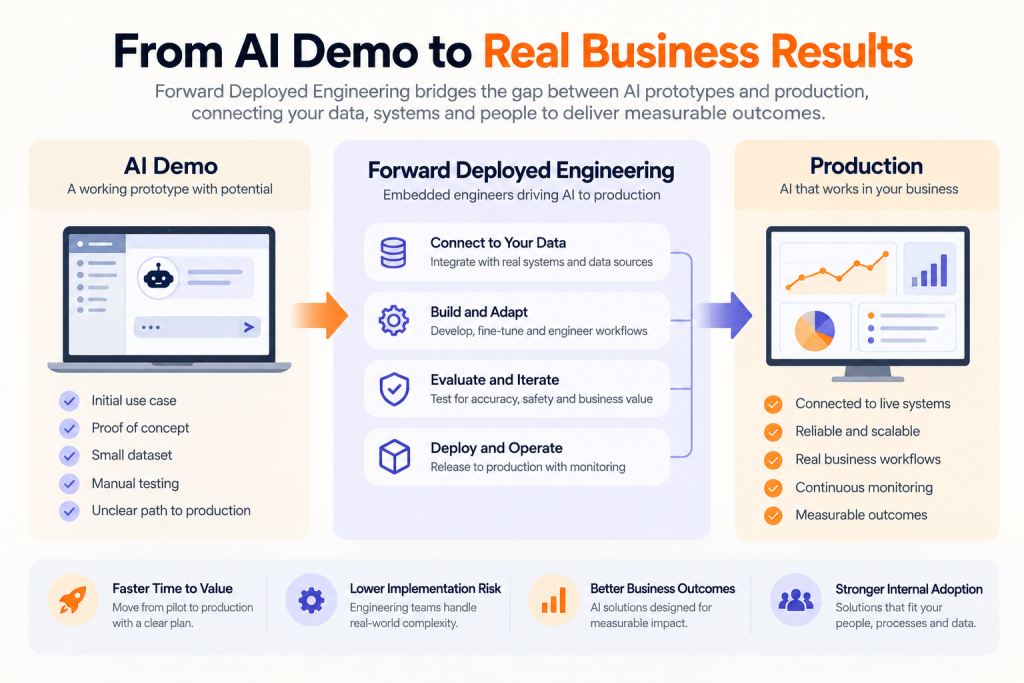
An AI prototype can look impressive in a demonstration. However, turning that prototype into a solution that works with real business data, existing software, security requirements, and everyday workflows requires additional engineering work.
The challenge goes beyond demonstrating what AI can do. Businesses also need to connect AI capabilities to practical problems and deliver solutions that work reliably in real operating environments.
Forward Deployed Engineering (FDE) offers one way to bridge this gap. Instead of separating business discovery, software development, integration, and deployment into disconnected stages, an FDE works closely with the customer’s team to understand the problem and deliver a solution in its actual operating environment.
For organizations moving beyond AI experimentation, this approach can help connect technical implementation with business value. Nevertheless, the right engagement depends on the project’s scope, risks, and requirements.
What Is Forward Deployed Engineering?
Forward Deployed Engineering is an approach to software and AI delivery in which engineers work closely with customers’ business and technical teams. They investigate real problems, understand existing systems, build solutions, integrate them into operating environments, and improve them through feedback from real usage.
Unlike a conventional project team that may receive a detailed specification and begin development, an FDE team can help clarify requirements through discovery, experimentation, testing, and iteration. This collaboration becomes particularly useful when business needs evolve or the technical requirements remain unclear during implementation.
The engineer does not work in isolation. Instead, the role connects technical execution with the customer’s business context.
Depending on the engagement, the work may include:
- Understanding business processes and identifying an appropriate AI use case.
- Evaluating data availability, quality, access, and privacy requirements.
- Integrating AI capabilities with existing applications, APIs, and workflows.
- Building the application and its supporting software components.
- Evaluating output quality, reliability, security, and failure cases.
- Deploying, monitoring, and improving the solution with stakeholder feedback.
The team should agree on these responsibilities at the beginning of the engagement. FDE describes a delivery model; it does not guarantee that every AI project will succeed.
Why AI Projects Can Struggle to Reach Production
A successful demonstration proves that a concept can work under particular conditions. However, it does not automatically prove that the solution is ready for everyday business use.
Several challenges can emerge when teams move from a prototype to a production application.
1. Business Data Is More Complicated Than a Demo
Real business information may reside across databases, documents, CRM platforms, internal tools, and legacy systems. Moreover, data can be incomplete, inconsistent, duplicated, or restricted by permissions.
An AI application needs the right information and must access it through appropriate controls. Depending on the use case, the team may need to prepare data, implement retrieval, develop APIs, and carefully manage access.
2. Existing Systems Still Need to Work Together
An AI capability rarely operates alone. For example, it may need to retrieve information from a CRM, update an order, create a support ticket, or assign work to an employee.
Consequently, the team must engineer the integration, authentication, error handling, serviceability, and testing that keep the workflow reliable. A standalone chat bot is not enough when the business needs a complete process that works from start to finish.
3. Output Quality Needs Evaluation
AI output can vary. A system that performs well on a few sample prompts may still fail on unusual requests, ambiguous information, or unfamiliar data.
Therefore, teams need evaluation criteria that reflect actual business tasks. These criteria may include factual accuracy, task completion, response time, cost, consistency, and appropriate escalation to a human.
4. Security and Permissions Cannot Be an Afterthought
Enterprise applications may handle sensitive business data, user roles, confidential information, logs, and the consequences of incorrect output.
For this reason, teams should establish suitable access controls, security reviews, and approval processes before allowing an AI feature to take consequential actions. The required safeguards depend on the industry, use case, and level of risk.
5. Launch Is Not the End of the Work
Once users interact with an AI application, the team may discover new requirements and failure cases. For example, users may need better retrieval, revised prompts, additional integration, improved evaluations, or redesigned workflow steps.
Production readiness therefore includes a plan for monitoring and maintenance. Teams must continue to review real-world performance rather than simply deploying the first working version.
Why Forward Deployed Engineering Is Receiving Attention
On October 2, 2026, Anthropic announced a $100 million commitment to Claude Frontier Academy, with the stated goal of training 10,000 Frontier Deployed Engineers by the end of 2027. Its initial cohorts include engineers from major consulting firms and enterprises.
Read Anthropic’s announcement.
The announcement connects FDE with helping organizations move AI from an idea into production systems. It signals investment in implementation talent, although it does not prove that every organization needs an FDE engagement.
For businesses evaluating AI, the practical lesson is straightforward: choosing a capable model is only one part of implementation. The surrounding engineering, business knowledge, integration, evaluation, and operational work also matter.
As a result, organizations should evaluate AI initiatives in terms of the complete solution they need to deliver—not just the model or prototype they can demonstrate.
How an FDE Connects an AI Idea to a Working Solution
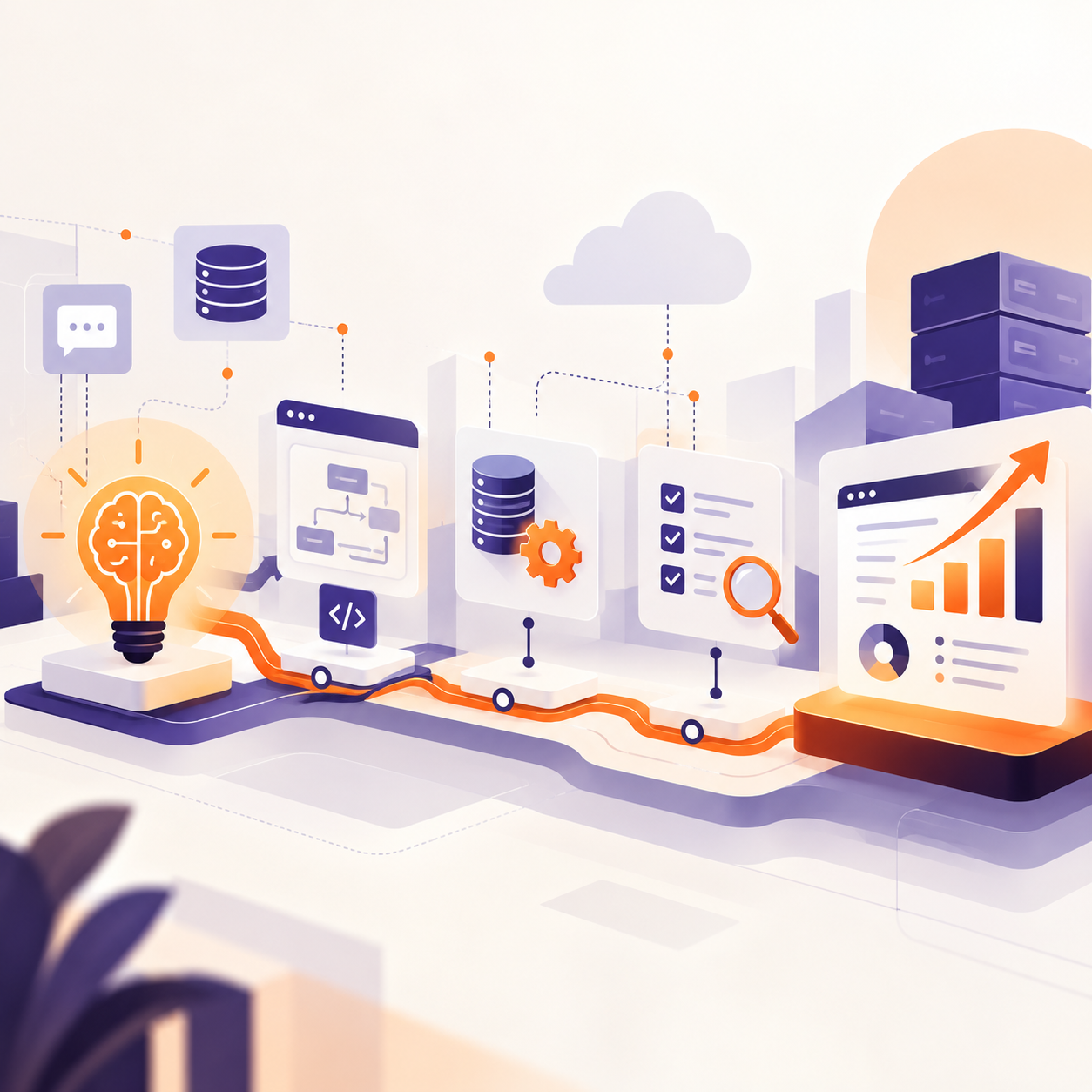
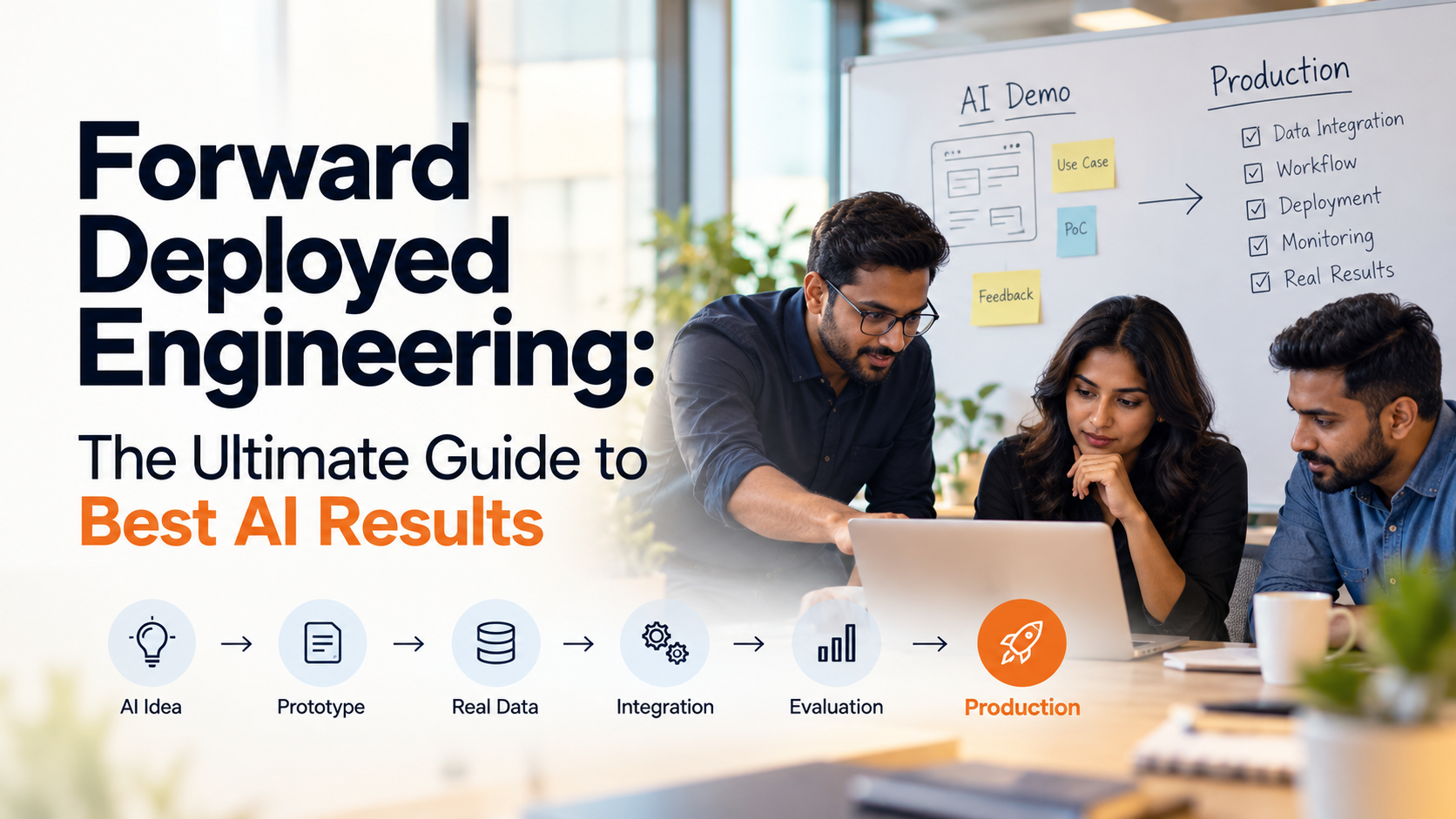
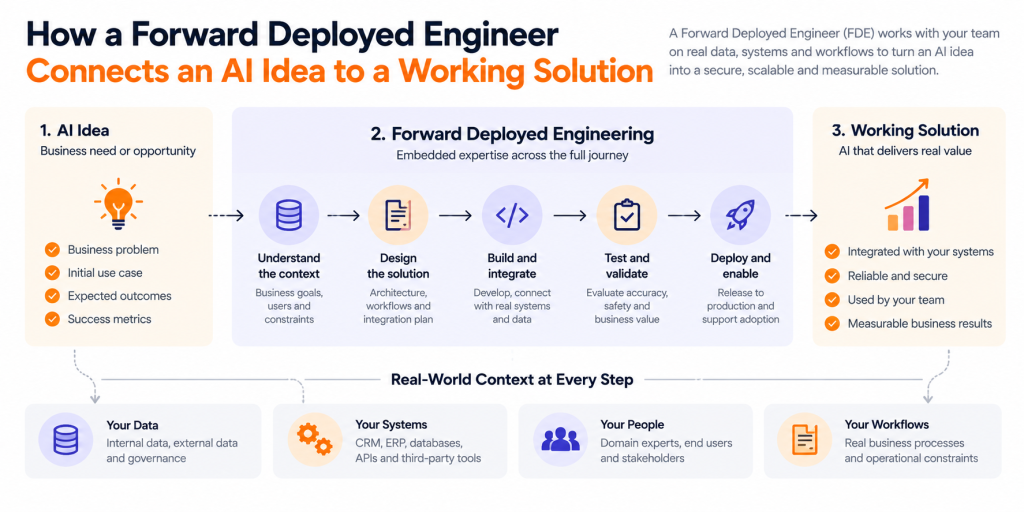
A practical FDE engagement can follow five stages. The stages may overlap, and the depth of each stage depends on the project.
Stage 1: Discover the Business Problem
Start with the workflow, not the technology. Identify the user, the problem, the current process, and the intended outcome.
Next, agree on what success means before committing to a solution. The team may reduce manual effort, accelerate processing, improve access to information, or create a better customer experience. Define how the team will evaluate the result.
Stage 2: Assess Data and Integrations
Identify the systems, datasets, APIs, and permissions that the solution needs. Then review technical constraints and security requirements early.
This stage helps the team determine whether the proposed use case is feasible. It also clarifies whether the first version should be a small experiment, a targeted integration, or a larger application.
Stage 3: Build the Solution
Develop the application components needed to support the use case. Depending on the requirements, the solution could include an LLM-powered interface, retrieval-augmented generation (RAG), workflow automation, an AI agent, or an integration with an existing web or mobile application.
Choose the architecture according to the business problem and its constraints—not simply because a particular technology is popular.
In addition, design the application to work with existing systems, permissions, and operational requirements. This helps the team build a solution that fits the business environment rather than an isolated demonstration.
Stage 4: Validate Before Rollout
Test the solution against representative tasks and failure cases. Evaluate output quality, access controls, reliability, performance, and cost.
Where appropriate, include human review, clear fallback behavior, and safeguards against unintended actions. Use agreed acceptance criteria to decide whether the solution is ready for broader use.
Stage 5: Deploy, Monitor, and Improve
Roll out the application in a controlled way. Monitor real-world behavior, collect user feedback, and track the agreed success measures.
Then use those findings to improve the system. Documentation, knowledge transfer, and clear ownership should also form part of the delivery plan.
By following these stages, businesses can connect discovery, engineering, validation, and production operations in one practical delivery process.
When Should a Business Consider an FDE?
Forward Deployed Engineering may be a good fit when:
- An AI proof of concept works, but the team has not resolved the production integration requirements.
- The use case is clear enough to explore, but the final requirements will emerge through implementation.
- An internal team needs additional hands-on engineering capacity for an AI initiative.
- Several business systems must connect to deliver the intended workflow.
- The solution requires close collaboration between product, engineering, operations, and business stakeholders.
However, FDE is not the best choice for every project. A strategy engagement may be more appropriate when the business problem remains undefined. Similarly, a conventional development project may suit a stable specification, while staff augmentation may be sufficient when the internal team already has a clear plan and needs extra capacity.
The best engagement model depends on the problem, internal capabilities, risk, and level of ownership required.
How to Evaluate an AI Implementation Partner
Before engaging an external team, ask practical questions about its delivery approach and engineering capabilities.
- How will the team understand the business workflow and define success?
- What experience does the team have with the relevant data, integration, and application architecture?
- How will the team evaluate AI output quality and failure cases?
- How will the team handle security, permissions, and sensitive data?
- Who will manage deployment, monitoring, and post-launch improvements?
- How will the team document the solution and transfer knowledge?
- What deliverables, acceptance criteria, and decision points will the team agree on?
A strong proposal should clearly define the scope, responsibilities, risks, and success criteria. It should also distinguish what the team can demonstrate now from what it still needs to validate.
Furthermore, ask how the team will handle unexpected technical constraints and changing requirements. A credible implementation plan should explain how the team will assess trade-offs, communicate risks, and make decisions throughout delivery.
How O Clock Software Can Help
O Clock Software provides software development and AI-related engineering services for businesses that need to build or extend digital products. Depending on the requirements, the engagement can include AI application development, integration with existing systems, and dedicated engineering support.
Our Forward Deployed Engineering service describes an embedded engagement model for organizations that need engineering support from discovery through implementation and iteration.
Our AI solutions and services provide another starting point for discussing an AI use case, its technical requirements, and the path toward implementation.
We also offer AI app development services for businesses that need help building or extending AI-powered applications.
The appropriate approach depends on your situation. You may need an embedded engineer, a dedicated team, or a clearly scoped development engagement. The first step is to understand the problem and determine which model fits.
Move Beyond the AI Demo
An AI demonstration can establish that an idea is possible. However, delivering business value requires further decisions: which workflow to improve, how to connect the necessary systems, how to evaluate the result, and how to support it after launch.
Forward Deployed Engineering brings these decisions closer to the engineering work. It can help connect business discovery, implementation, and real-world feedback within a continuous process.
Planning to move an AI initiative from prototype to production? Talk to O Clock Software about your engineering requirements.
Share the use case, the systems involved, and the main implementation challenge. That gives both teams a more useful starting point for assessing the next step.