From Cloud to AI: Why Modernization Is No Longer Just About Migration
From Cloud to AI: Why Modernization Is No Longer Just About Migration

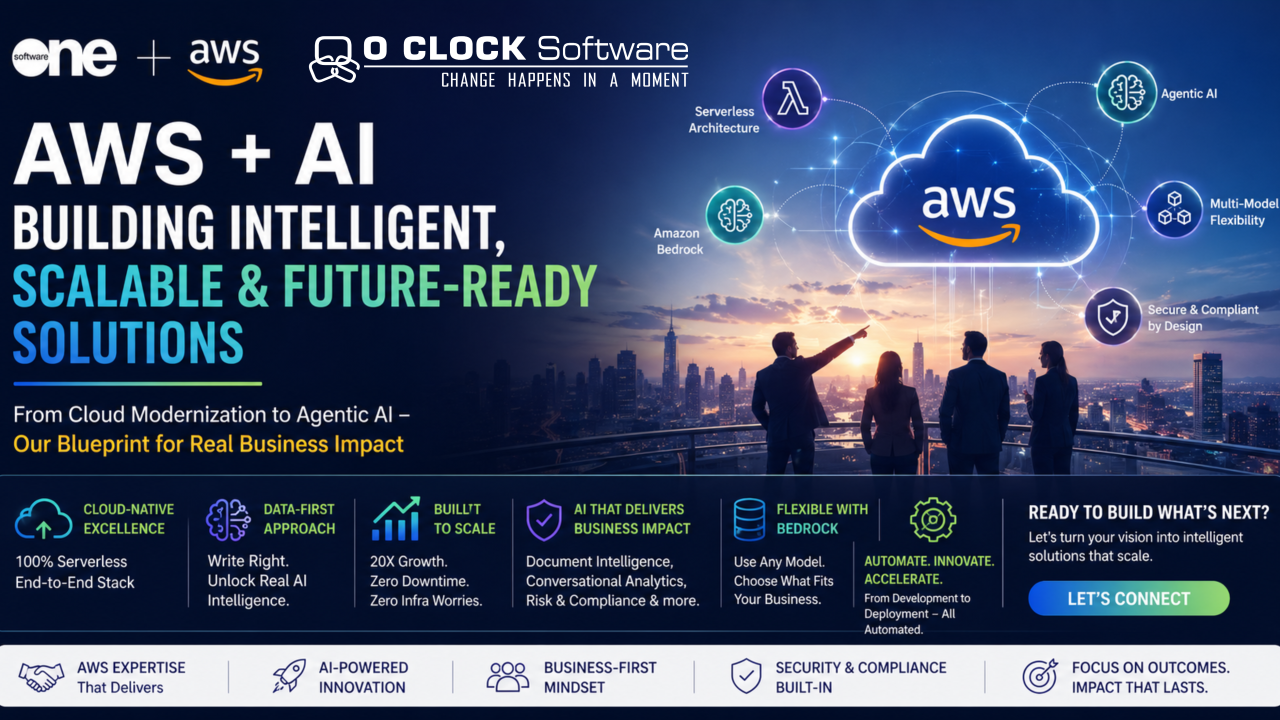
Today, I attended an insightful session focused on how organizations are moving from legacy infrastructure toward cloud-native, AI-powered platforms. What made the discussion particularly valuable was that it stayed grounded in implementation reality. This was not another generic AI conversation filled with future predictions and presentation slides. The session focused on operational scale, architecture decisions, deployment models, and how businesses are actually restructuring systems around intelligence.
One statement from the session captured the shift perfectly:
“Cloud is no longer the destination. It is the foundation. AI is what delivers the value.”
That line stayed with me because it accurately reflects where enterprise technology is heading now. A few years ago, cloud migration itself was considered transformation. Today, migration alone is not enough. Infrastructure modernization without intelligence is quickly becoming incomplete modernization.
The Real Shift Begins After Migration
The session walked through the familiar enterprise transition path:
- Assess
- Mobilize
- Migrate
- Modernize
But the important insight was this: modernization is no longer purely infrastructural. The real transformation starts when systems become intelligent enough to interpret data, automate workflows, generate operational insights, and support business decisions continuously.
This changes how software systems are designed.
Traditional enterprise systems were built primarily to store information and execute workflows. Modern systems are increasingly expected to understand patterns, predict outcomes, and reduce operational friction proactively. That is a very different architectural mindset.
“The interface is no longer the system. Intelligence is.”
One of the strongest themes discussed during the session was serverless architecture. A real-world implementation example demonstrated nearly 20x scale growth without infrastructure changes or manual server intervention. That is not just operational efficiency. It represents a fundamental shift in how scalability itself is approached.
The old infrastructure mindset was based on capacity planning. The newer mindset is based on elasticity and event-driven execution.
This aligns strongly with how modern engineering teams increasingly think about architecture:
- cloud-native backend systems
- event-driven processing
- scalable APIs
- minimal operational overhead
- infrastructure automation
The important difference is that systems are no longer being designed for current load. They are being designed for unpredictable growth.
AI Is Becoming a Data Architecture Problem
One of the most practical discussions during the session focused on AI hallucination. Interestingly, the conversation did not blame models.
Instead, the session made a much sharper point:
“AI does not fail because of models. AI fails because of how data is prepared and presented.”
That observation is incredibly important because many organizations still approach AI implementation as a model-selection exercise. In practice, successful AI systems depend far more on data structure, retrieval quality, contextual filtering, and orchestration pipelines than on the model itself.
This is where many early AI projects struggle after promising prototypes. Impressive demos are relatively easy. Reliable production systems are not.
The discussion emphasized the need for:
- clean and structured data
- context-aware retrieval
- controlled input pipelines
- domain-specific filtering
- grounded responses instead of generic outputs
This is also why AI architecture is quietly becoming one of the most important engineering conversations inside enterprise software today. Intelligence without reliable data infrastructure becomes operational risk very quickly.
Traditional Systems vs AI-Driven Systems
| Traditional Systems | AI-Driven Systems |
|---|---|
| Store business data | Interpret business data |
| Static workflows | Adaptive workflows |
| Manual operations | Assisted operations |
| Dashboard reporting | Predictive insights |
| Feature-centric | Intelligence-centric |
Multi-Model AI Is Becoming the New Standard
Another important shift discussed during the session was the growing move away from single-model dependency. The conversation is changing from:
“Which model is best?”
to:
“How do we design systems that use the right model for the right task?”
That distinction matters.
Different workloads require different capabilities. Some models are optimized for reasoning, some for speed, some for retrieval, some for structured generation, and some for cost efficiency. Intelligent architecture increasingly means orchestrating multiple models together rather than depending on one centralized system.
This multi-model approach creates:
- better accuracy
- operational flexibility
- lower AI costs
- use-case optimization
- reduced vendor dependency
The companies moving fastest right now are not necessarily the ones using the largest models. They are the ones building the smartest orchestration layers around them.
DevOps Is Quietly Becoming Conversational
One of the most forward-looking discussions from the session focused on deployment workflows and operational automation. The idea of “chat-to-deploy” workflows sounded futuristic not long ago, but the direction now feels increasingly practical.
Infrastructure generation, deployment execution, operational diagnostics, and environment management are steadily becoming more conversational and automated. Development workflows themselves are evolving:
Development → Automation → Intelligent Automation
This shift is bigger than tooling convenience. It changes how engineering teams interact with infrastructure altogether.
Modern cloud systems are becoming operationally abstracted. Teams are spending less time managing servers and more time designing workflows, policies, orchestration systems, and intelligence layers.
And honestly, that is where engineering focus should be moving.
The Businesses That Win Will Build Better Systems — Not Just More Software
The biggest takeaway from the session was not about AI models, cloud vendors, or frameworks. It was about architectural thinking.
The companies creating long-term advantage are building systems that scale operationally, adapt intelligently, and evolve alongside the business itself.
That requires:
- strong cloud-native architecture
- scalable deployment strategies
- reliable data engineering
- AI-ready operational design
- production-focused execution
Most importantly, it requires thinking beyond feature delivery.
“The future will not be defined by who uses AI. It will be defined by who uses AI correctly.”
That probably summarizes the entire session best.
Because “correctly” does not simply mean adding AI interfaces into products. It means designing systems with the right architecture, the right data foundation, and the right operational intelligence underneath them.
Cloud changed infrastructure.
AI is now changing the system itself.