How O Clock Software Builds Real-World AI Systems Beyond Chatbots and Hype
The AI industry currently has a presentation problem.
Every platform suddenly has a chatbot. Every dashboard claims to be “AI-powered.” Every product demo includes a glowing assistant panel sliding in from the right side of the screen. But once the demo ends, many businesses quietly discover the same uncomfortable truth: the system itself has not actually become smarter.
The interface changed. The operations did not.
That gap is becoming impossible to ignore, especially for companies trying to scale software across logistics, healthcare, retail, warehousing, finance, and enterprise operations. Businesses are no longer asking whether AI can generate responses. They are asking whether AI can reduce operational friction, improve decisions, automate complexity, and meaningfully change execution.
That is a very different engineering problem.
At O Clock Software, we have been approaching AI less like a visual feature and more like an operational layer integrated into real systems. In many projects, the chatbot ends up being the smallest component of the overall architecture.
“The interface is no longer the system. Intelligence is.”
The most important shift happening right now is not conversational AI. It is workflow intelligence.
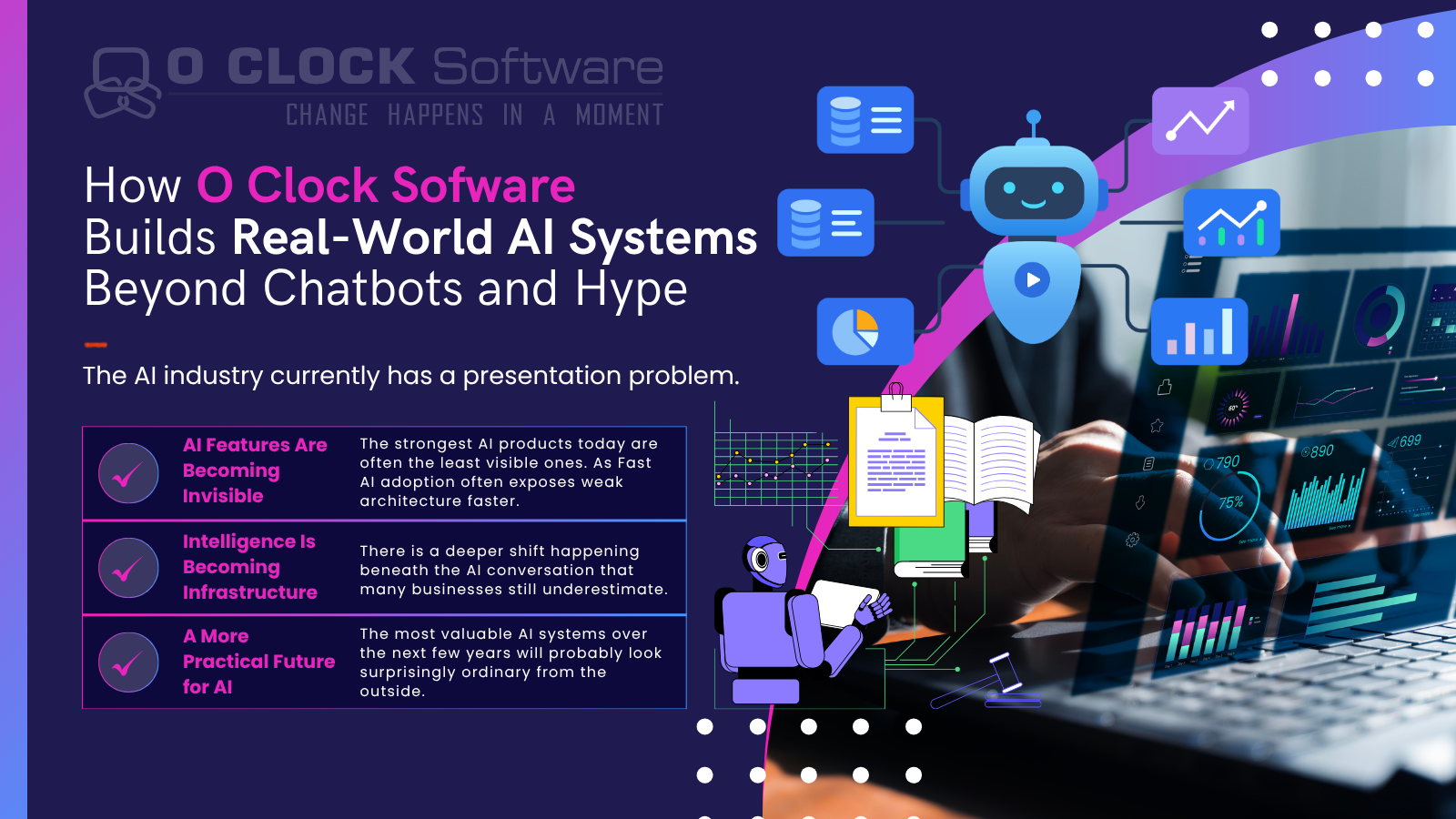
AI Features Are Becoming Invisible
The strongest AI products today are often the least visible ones.
Users may never realize an AI system predicted inventory shortages before they happened, prioritized support escalations automatically, optimized delivery routes dynamically, or detected abnormal operational behavior in real time. Yet those systems create measurable business value far beyond a conversational interface.
This is where many AI initiatives struggle. Companies frequently begin with the surface layer instead of the operational foundation underneath it. They add AI-generated text to products while still relying on fragmented workflows, disconnected APIs, legacy architecture, and manually dependent operations.
Fast AI adoption often exposes weak architecture faster.
We see this regularly when modern AI services are introduced into older enterprise ecosystems. Suddenly, latency becomes visible. Data quality problems become obvious. Event flows break under scale. Mobile synchronization issues appear. Security boundaries become harder to maintain. AI does not magically solve architectural debt. In many cases, it magnifies it.
That is why real-world AI engineering requires a broader systems mindset.
At O Clock Software, AI projects are usually built alongside:
- workflow orchestration
- mobile infrastructure
- enterprise APIs
- cloud scalability
- event-driven systems
- automation pipelines
- operational monitoring
- human approval layers
The intelligence layer only works when the surrounding architecture is stable enough to support it.
Traditional Software vs AI-Native Systems
| Traditional Applications | AI-Native Systems |
|---|---|
| Reactive workflows | Predictive workflows |
| Fixed user paths | Context-aware decision flows |
| Manual operational triggers | Automated intelligence loops |
| Static reporting | Continuous insight generation |
| Interface-driven interactions | Outcome-driven interactions |
This transition changes how software products are designed from the ground up.
Earlier enterprise systems focused heavily on user actions. Modern AI-native systems increasingly focus on intent, prediction, prioritization, and operational context. The software is no longer waiting for users to tell it what happened. It is learning to recognize patterns before the user even notices them.
That changes product engineering completely.
The App Is No Longer the Product
One of the biggest misconceptions in AI adoption is assuming the application itself remains the center of the experience.
It does not.
The real product increasingly lives inside the orchestration layer behind the interface: recommendations, automation flows, contextual processing, predictive analysis, adaptive workflows, and system-level intelligence. Mobile apps, dashboards, and admin panels are becoming access points into intelligence infrastructure rather than standalone products.
“Users now compare software against the smartest product they used yesterday.”
That expectation shift is happening faster than many businesses realize.
A retail platform is now expected to predict purchasing behavior. A logistics platform is expected to optimize delivery flows automatically. A healthcare application is expected to surface operational anomalies intelligently. SaaS platforms are expected to personalize workflows dynamically rather than offering generic dashboards to everyone.
The challenge is that building these systems requires far more than integrating an LLM API.
Real AI systems require:
- structured data pipelines
- operational observability
- scalable backend architecture
- human review mechanisms
- mobile synchronization strategies
- infrastructure resilience
- domain-specific modeling
- security-aware orchestration
This is precisely why product engineering experience matters more now than ever before. AI systems fail quickly when engineering fundamentals are weak.
For businesses building mobile-first AI experiences, our teams frequently integrate intelligence layers directly into scalable cross-platform ecosystems using technologies like Flutter, React Native, Node.js, Laravel, and enterprise cloud services. Companies looking to accelerate mobile AI product development often work with our dedicated engineering teams through:
- Hire iOS Mobile App Developers
- Hire Android Mobile App Developers
- Hire Flutter App Developers
- Hire React Native Developers
The future of AI products will not belong to companies with the loudest demos. It will belong to companies whose systems quietly operate better every single day.
Intelligence Is Becoming Infrastructure
There is a deeper shift happening beneath the AI conversation that many businesses still underestimate.
AI is slowly moving out of the “feature layer” and into the infrastructure layer.
Earlier cloud transformations changed where systems operated. AI transformations are changing how systems operate. That distinction matters. We are moving from software that executes instructions toward software that continuously interprets context.
And context changes everything.
A warehouse system behaves differently when inventory demand spikes unexpectedly. A SaaS workflow behaves differently when customer risk patterns change. A field operations platform behaves differently during operational disruptions. AI-native architecture allows systems to adapt instead of simply respond.
“The real competitive advantage is no longer features. It is operational intelligence.”
This is why many AI conversations now feel strangely shallow. The industry still spends enormous energy discussing prompts while the real long-term value is being created inside orchestration, automation, predictive systems, infrastructure design, and operational learning loops.
The companies that understand this early are not just adding AI to products.
They are redesigning how products think.
A More Practical Future for AI
The most valuable AI systems over the next few years will probably look surprisingly ordinary from the outside.
They will not always have flashy interfaces or viral demos. In many cases, users may barely notice the intelligence itself. What they will notice is smoother operations, faster decisions, fewer bottlenecks, better recommendations, lower friction, and systems that feel increasingly adaptive.
That is where AI becomes commercially meaningful.
Not as spectacle.
As infrastructure.
And that shift has already started.