Restaurant POS Modernization With Android Smart POS
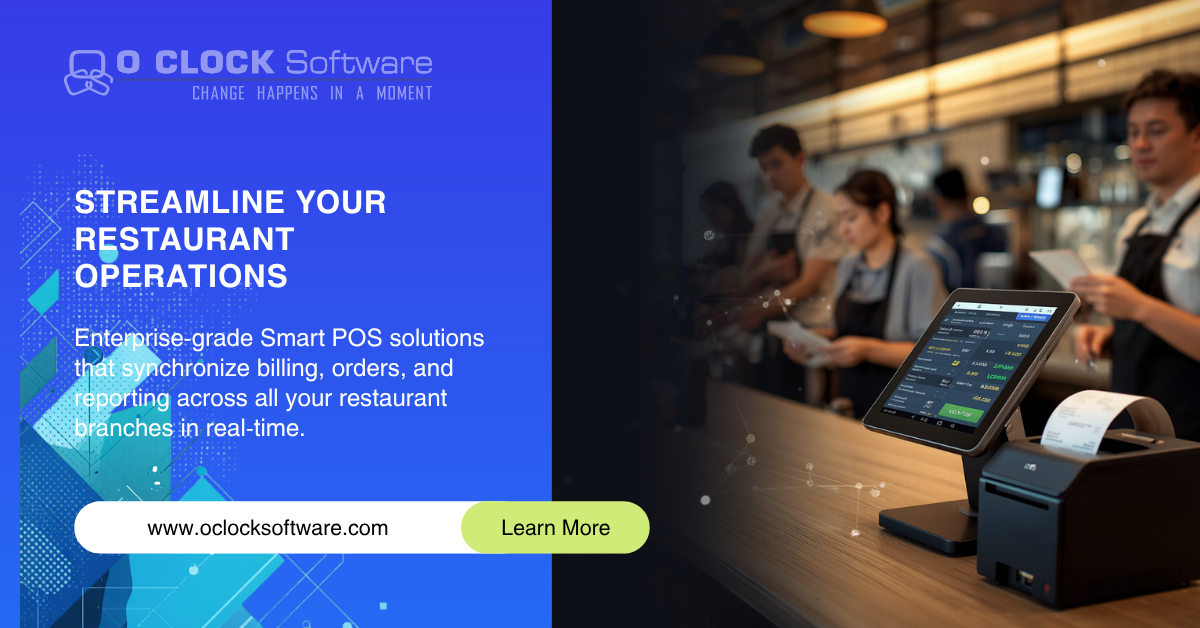
Peak dinner hours exposed the problem faster than any internal audit ever could.
Cashiers were forced to wait for outdated billing terminals to respond while order queues kept growing. Managers from different restaurant branches spent late evenings reconciling sales data manually because reporting systems were disconnected from day-to-day operations. Menu changes required branch-by-branch updates. Printer failures interrupted billing during busy service windows. Even simple operational decisions depended heavily on phone calls between branches.
The restaurant business itself was growing steadily.
Its technology foundation was not.
What initially started as a small billing inconvenience gradually became a structural operational bottleneck affecting customer experience, reporting accuracy, and branch scalability.
The organization needed more than a billing application upgrade. It needed a unified operational system capable of supporting multi-location restaurant management in real time.
That requirement eventually led to the development of a centralized Android-based Smart POS ecosystem engineered by O Clock Software Pvt Ltd.
When Restaurant Expansion Outgrows Legacy Billing Systems
The restaurant group operated across multiple locations with independent billing environments at each branch.
Over time, every branch evolved differently.
Some locations used older desktop billing systems. Others depended on locally installed software with inconsistent data synchronization. A few branches maintained semi-manual reporting workflows where sales reconciliation was still handled through spreadsheets at the end of each day.
Operational inconsistency became increasingly visible.
The management team identified several recurring problems:
- Billing slowdowns during high customer traffic
- Inconsistent menu and pricing updates across branches
- Lack of centralized operational visibility
- Delayed sales reporting
- Printer compatibility instability
- No reliable real-time branch synchronization
- Limited scalability for future expansion
- Difficulty monitoring branch-level operational performance
The existing systems were designed primarily for local billing execution, not for modern restaurant operations spanning multiple synchronized locations.
From an infrastructure perspective, the architecture lacked three critical capabilities:
- Real-time operational synchronization
- Centralized visibility
- Device-level scalability
Without solving these foundational gaps, adding new branches would only amplify operational complexity.
Rethinking the POS System as an Operational Platform
One of the most important architectural decisions made during the early planning phase was avoiding the common mistake of treating the POS system purely as billing software.
Instead, the platform was redesigned as an operational control layer connecting:
- Billing
- Order management
- Kitchen workflows
- Reporting
- Branch synchronization
- Device management
- User roles
- Menu management
- Cloud visibility
This shift fundamentally changed the implementation strategy.
Rather than building isolated modules, the engineering focus moved toward creating a scalable ecosystem where branch operations could function independently during temporary connectivity interruptions while still maintaining centralized cloud synchronization.
That balance between local execution and cloud coordination became one of the core architectural priorities.
Why Android Smart POS Devices Became the Preferred Direction
The organization initially evaluated traditional desktop billing systems alongside tablet-based alternatives.
However, Android Smart POS devices introduced several operational advantages that aligned more naturally with restaurant workflows.
The decision was influenced by practical deployment realities rather than trend-driven technology adoption.
Android-based Smart POS devices offered:
- Integrated thermal printer support
- Compact counter footprint
- Faster deployment across branches
- Reduced hardware complexity
- Improved mobility within restaurant environments
- Easier maintenance and replacement cycles
- Better cost scalability for expansion
- Simplified onboarding for staff
Most importantly, these devices allowed the application ecosystem to remain tightly integrated with hardware-level workflows without requiring excessive middleware layers.
That reduced several points of operational failure common in fragmented POS environments.
Engineering the Cloud Synchronization Layer
The most technically sensitive part of the implementation was not billing.
It was synchronization consistency.
Restaurant operations cannot pause because internet connectivity becomes unstable for a few minutes. Branches still need to process orders, print receipts, and complete transactions without interruption.
To address this, the architecture was designed using a hybrid synchronization model.
Each Android Smart POS device maintained localized operational handling for:
- Active orders
- Temporary transaction storage
- Receipt generation
- Session continuity
Simultaneously, a cloud synchronization engine managed:
- Centralized reporting
- Multi-branch data aggregation
- Menu synchronization
- Inventory updates
- User management
- Analytics visibility
This approach reduced dependency on continuous internet connectivity while still preserving centralized operational intelligence.
The synchronization engine also required conflict-handling logic for scenarios where multiple operational updates occurred simultaneously across branches.
Instead of forcing strict real-time dependency, the system prioritized operational continuity first and synchronization consistency second.
That tradeoff proved critical during deployment in high-volume restaurant environments.
Simplifying the Billing Workflow at the Counter
One operational insight quickly became obvious during user observation sessions.
Cashiers were spending too much time navigating screens rather than processing customers.
The interface redesign focused heavily on reducing friction inside the billing workflow.
The updated POS experience introduced:
- Faster menu navigation
- Simplified modifier handling
- Category-based order flows
- Quick repeat order actions
- Integrated payment workflows
- Streamlined receipt printing
- Reduced screen transitions
The goal was not visual sophistication.
The goal was operational speed under pressure.
Even small interface optimizations produced measurable improvements during busy service windows because they reduced cognitive overhead for front-desk staff.
This became especially important for restaurants operating with temporary or rotating staff during weekends and seasonal demand spikes.
Multi-Branch Visibility Changed Management Behavior
One of the biggest operational transformations happened outside the billing counter.
Before modernization, branch reporting depended heavily on end-of-day reconciliation processes. Management teams often reviewed operational performance several hours after business activity had already occurred.
The new centralized reporting environment changed how decisions were made.
Branch-level visibility became available in near real time.
Management teams could monitor:
- Sales performance
- Billing activity
- Order volumes
- Peak operating hours
- Branch productivity
- User-level activity
- Transaction trends
Instead of reacting to yesterday’s operational problems, the organization could monitor active business movement while operations were still running.
That visibility reduced operational blind spots significantly.
Printer Stability Became a Critical Deployment Priority
Thermal printer integration sounds minor during planning discussions.
In production restaurant environments, it becomes mission critical.
Receipt failures directly affect customer flow.
Kitchen ticket interruptions immediately impact order fulfillment.
The engineering team spent considerable effort stabilizing printer communication layers across different Android Smart POS hardware environments.
The implementation included:
- Automatic printer reconnect handling
- Print queue management
- Failure recovery mechanisms
- Background print retry logic
- Device-specific compatibility testing
These operational safeguards prevented minor hardware interruptions from escalating into front-desk service disruptions.
In many enterprise deployments, reliability improvements often matter more than feature expansion.
This implementation reinforced that principle repeatedly.
Scaling Beyond the First Few Branches
Many restaurant systems work effectively for three or four locations.
The real architectural pressure begins when operational growth accelerates.
The platform was designed with expansion readiness in mind from the beginning.
The backend infrastructure supported:
- Centralized branch onboarding
- Dynamic menu configuration
- Role-based access management
- Device registration workflows
- Modular reporting structures
- Branch-specific operational customization
This prevented future expansion from requiring major architectural rewrites.
More importantly, it allowed the business to maintain operational consistency while growing geographically.
That consistency became increasingly valuable as the restaurant group expanded its operational footprint.
Operational Outcomes After Modernization
The modernization effort delivered improvements across multiple operational layers.
Billing execution became faster and more stable during high-volume hours.
Branch synchronization reduced manual coordination effort between locations.
Management reporting became significantly more accessible and timely.
Staff onboarding became easier because Android-based workflows felt more intuitive compared to older desktop systems.
Operational visibility improved across both branch management and leadership teams.
Most importantly, the organization gained a scalable restaurant operations foundation capable of supporting future expansion without repeating earlier infrastructure limitations.
The transformation was not driven by cosmetic modernization.
It was driven by operational practicality.
Engineering Lessons From the Deployment
Several important implementation lessons emerged throughout the rollout.
Operational continuity matters more than theoretical perfection
Restaurant systems must continue functioning even under unstable network conditions. Designing for operational resilience proved more valuable than forcing strict cloud dependency.
Hardware integration should never be underestimated
POS ecosystems are deeply tied to real-world hardware behavior. Printer stability, device handling, and peripheral management directly affect customer-facing operations.
Simplicity improves adoption
The most effective workflows were often the simplest ones. Staff adoption improved when operational complexity was reduced instead of expanded.
Centralization should not create operational rigidity
Branches still required localized flexibility while benefiting from centralized oversight. Balancing those two priorities became essential for long-term scalability.
Building Future-Ready Restaurant Technology Infrastructure
Modern restaurant operations increasingly depend on synchronized digital ecosystems rather than standalone billing software.
As restaurant businesses expand across locations, operational coordination becomes more complex than transaction processing itself.
This implementation demonstrated how Android Smart POS infrastructure, cloud synchronization, and centralized operational visibility can work together to modernize restaurant operations without disrupting active business continuity.
For growing restaurant organizations, the future of POS systems is no longer limited to billing efficiency.
It is increasingly tied to operational intelligence, scalability readiness, mobility, and infrastructure adaptability.
That broader perspective is where modern restaurant technology investments begin delivering long-term strategic value.