

How a Multi-Service Appointment Booking Platform Enabled Business Automation at Scale
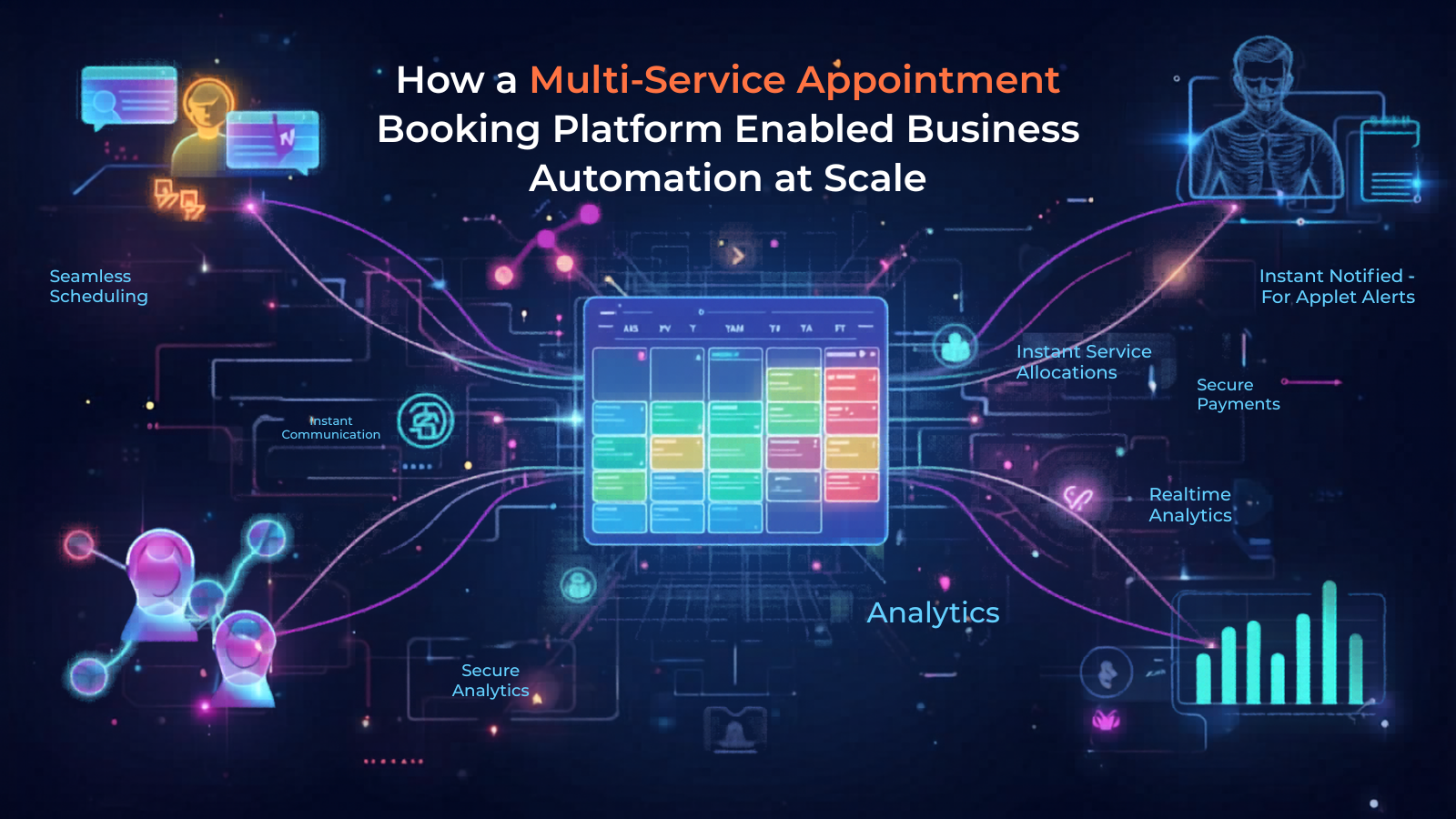
Modern appointment-driven businesses rarely operate in a single workflow anymore. What began as a simple booking requirement for one startup quickly expanded into a multi-service operational ecosystem involving scheduling, notifications, staff coordination, payment processing, customer engagement, analytics, and real-time availability management.
The challenge was not building “another booking app.”
The real challenge was creating an operational platform capable of supporting continuous business iteration without multiplying engineering complexity every quarter.
The startup behind the platform was preparing for rapid expansion across multiple service categories. Their initial MVP had validated demand, but the underlying architecture was already beginning to show signs of strain. Separate mobile development tracks, fragmented workflows, and increasing operational dependencies were slowing product delivery far earlier than expected.
What the company needed was not simply feature acceleration.
They needed engineering leverage.
When Product Growth Starts Outpacing Operational Structure
The original platform was designed around a relatively straightforward booking workflow. Customers could browse services, choose slots, and confirm appointments. Internally, however, the business had already started evolving into something far more operationally intensive.
Different service providers required independent availability logic. Notification timing varied between categories. Certain appointments needed recurring workflows, while others triggered dynamic reminders, escalation rules, or post-service engagement actions.
As the platform expanded, the startup encountered a common SaaS problem: operational logic was spreading faster than the system architecture could comfortably support.
The company initially considered maintaining separate native applications for iOS and Android. On paper, that appeared manageable during early MVP stages. In practice, it introduced release synchronization problems almost immediately.
Small product changes required parallel development efforts, duplicated QA cycles, and inconsistent deployment timelines.
“Scalability problems usually appear long before traffic problems.”
The engineering concern was not only cost. It was velocity degradation.
Every new workflow increased operational dependency between teams.
Every feature release became harder to coordinate.
Every platform-specific inconsistency created customer support friction.
The startup needed a development strategy that reduced fragmentation before scale amplified it further.
Choosing Cross-Platform Architecture Without Compromising Performance
The decision to adopt Flutter and React Native was not driven by trend adoption. It was driven by operational mathematics.
The engineering objective was straightforward:
Accelerate release cycles
Minimize duplicated business logic
Reduce long-term maintenance overhead
Preserve near-native performance
Enable faster experimentation for product teams
The architecture strategy combined shared mobile codebases with scalable backend APIs designed around service modularity rather than rigid feature grouping.
For mobile delivery, the platform adopted a hybrid cross-platform approach depending on workflow sensitivity and product requirements. Flutter was heavily utilized for consistent UI rendering and rapid iteration across consumer-facing modules, while React Native supported integration-heavy components where JavaScript ecosystem flexibility accelerated implementation.
Rather than tightly coupling frontend logic with backend services, the engineering team established centralized API orchestration layers that controlled scheduling logic, provider availability, notifications, and transactional workflows independently.
This separation became one of the most important architectural decisions in the project.
It allowed the mobile applications to evolve rapidly without repeatedly restructuring backend workflows.
“Automation only works when workflows themselves are operationally clean.”
That principle influenced nearly every engineering decision throughout the platform redesign.
Building for Operational Scale Instead of Initial Traffic
One of the more overlooked realities in SaaS systems is that operational complexity usually becomes a larger bottleneck than user volume during early growth phases.
The startup’s biggest engineering concern was not millions of concurrent users.
It was workflow unpredictability.
Appointment systems appear simple externally, but internally they involve highly dynamic coordination patterns:
Real-time slot locking
Cancellation propagation
Provider availability synchronization
Delayed notification scheduling
Payment state reconciliation
Multi-timezone scheduling logic
Conflict resolution workflows
The backend APIs were redesigned with asynchronous processing pipelines to prevent notification spikes and scheduling updates from blocking transactional workflows.
Push notification infrastructure was also re-architected to support behavioral triggers rather than static reminders alone. The platform eventually supported automated reminders, waitlist alerts, provider reassignment notifications, and customer engagement flows from a unified notification engine.
This became especially important as the startup expanded service categories.
Operational flexibility mattered more than feature count.
To improve deployment consistency, CI/CD workflows were introduced across mobile and backend services. Smaller deployment batches significantly reduced rollback complexity and enabled faster release confidence.
Instead of quarterly feature drops, the platform shifted toward continuous delivery cycles with smaller operational updates released incrementally.
That transition had substantial business implications.
Reducing Maintenance Complexity Through Shared Engineering Workflows
One of the most measurable improvements came from reducing duplicated engineering effort across platforms.
Before the transition, mobile development cycles often diverged between iOS and Android implementations. Small UI changes required separate handling, QA validation differed between devices, and deployment coordination frequently delayed releases.
By consolidating major portions of the application stack into shared codebases, the engineering team significantly reduced synchronization overhead.
The outcome was not merely “faster development.”
It was improved operational predictability.
Release planning became easier.
Testing cycles became more structured.
Feature parity issues dropped substantially.
The startup also gained a major advantage that many early-stage SaaS companies underestimate: the ability to experiment faster.
Because deployment friction decreased, product teams could iterate on workflows, onboarding experiences, scheduling logic, and customer engagement strategies far more aggressively without creating engineering instability.
“AI adoption often exposes fragmented architecture faster than growth does.”
The same principle applies to SaaS automation.
The more intelligent the workflows become, the more dangerous fragmented systems become underneath them.
The shared architecture reduced that risk significantly.
Operational Outcomes That Changed Product Velocity
Over time, the transformation produced several measurable operational improvements:
Area Before Transformation After Transformation
Mobile Release Coordination Separate platform cycles Unified deployment planning
Feature Iteration Speed Multi-week implementation Rapid incremental delivery
Maintenance Overhead High duplicate effort Shared engineering workflows
Notification Infrastructure Static reminders Event-driven automation
Backend Scalability Tightly coupled logic Modular API orchestration
QA Complexity Platform-specific validation Streamlined testing workflows
The platform also became operationally easier to expand into additional service categories because core scheduling and workflow orchestration systems were already modularized.
This prevented future scaling from becoming entirely engineering-dependent.
That distinction became strategically important for the business.
The company was no longer building features reactively.
It was building operational infrastructure capable of supporting evolving business models.
Engineering Lessons Behind the Transformation
One of the strongest takeaways from this project was that cross-platform development only succeeds when architectural discipline exists underneath the shared UI layer.
Simply sharing frontend code does not automatically create scalability.
What mattered here was:
clear backend separation
workflow modularity
API orchestration discipline
deployment consistency
operational observability
scalable notification infrastructure
The mobile frameworks accelerated delivery, but the real transformation came from aligning engineering structure with operational workflows.
That alignment allowed the startup to maintain startup-level agility without accumulating enterprise-level fragmentation.
The result was a platform capable of scaling operational complexity without proportionally increasing engineering burden.
And in modern SaaS businesses, that operational leverage often becomes more valuable than raw feature velocity itself.
Strategic Takeaway
Many startups initially treat mobile application development as a product delivery exercise.
In reality, it is often an operational systems problem disguised as a frontend project.
The companies that scale successfully are usually the ones that reduce architectural friction before growth magnifies it.
For this startup, Flutter and React Native were not simply technology choices. They became operational enablers that supported faster releases, cleaner workflows, and sustainable scaling decisions.
The transformation succeeded because the engineering strategy focused on long-term operational clarity instead of short-term feature acceleration alone.
Businesses planning similar platform initiatives often underestimate how quickly fragmented workflows can slow innovation.
That slowdown rarely appears suddenly.
It accumulates quietly through duplicated effort, deployment friction, inconsistent systems, and reactive architecture decisions.
Solving those problems early creates an entirely different growth trajectory.
For organizations exploring scalable cross-platform application development, investing in experienced engineering execution remains one of the most important strategic decisions in the product lifecycle.
Teams looking to scale modern mobile ecosystems often choose to work with specialized cross-platform experts through dedicated hiring models such as:
Hire Flutter Developers – https://www.oclocksoftware.com/hire-flutter-app-developers
Hire React Native Developers – https://www.oclocksoftware.com/hire-react-native-developers
Hire iOS Mobile App Developers – https://www.oclocksoftware.com/hire-ios-mobile-app-developers
Hire Android Mobile App Developers – https://www.oclocksoftware.com/hire-android-mobile-app-developers